
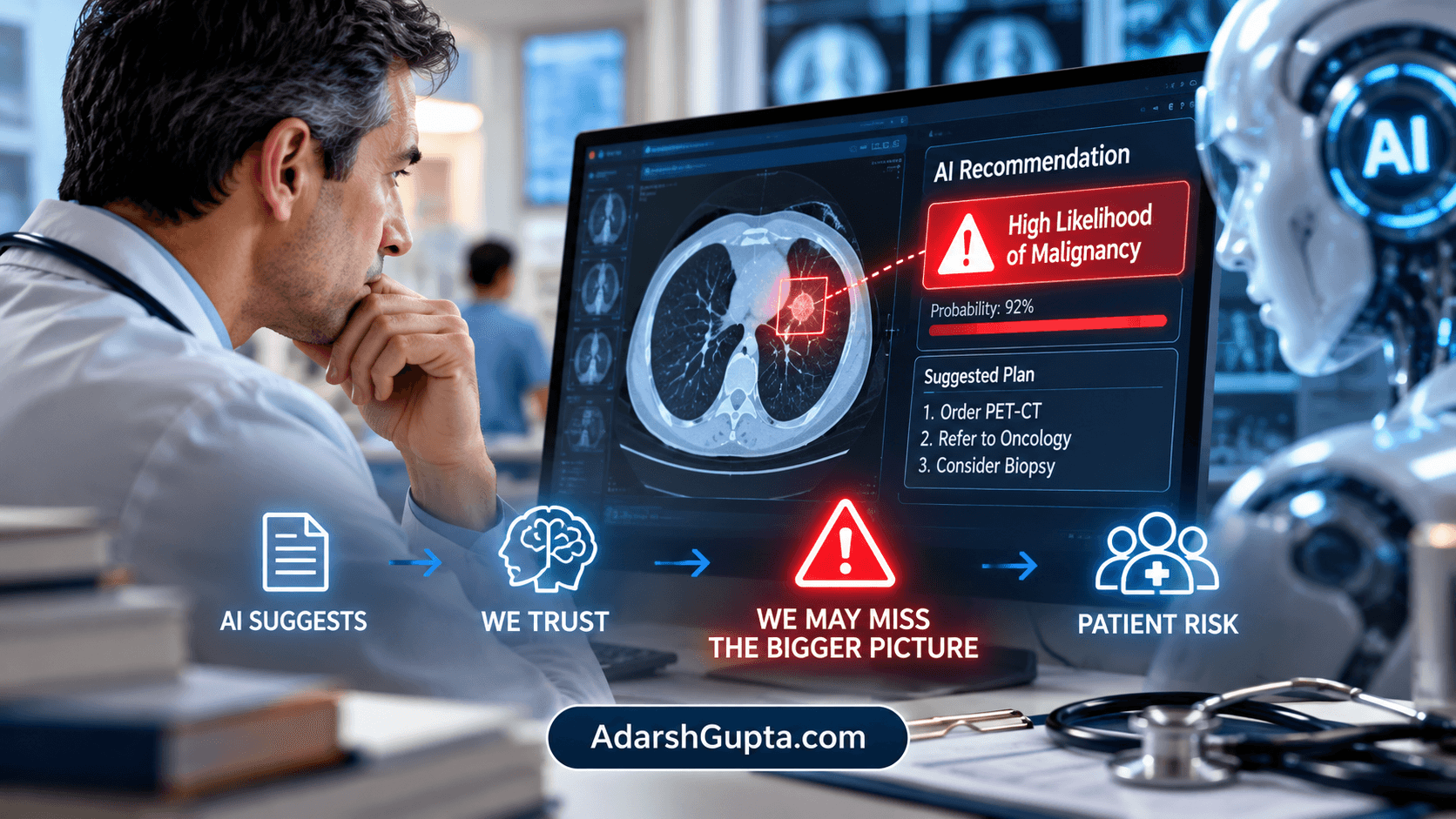
Automation Bias in Healthcare: The Hidden Risk of Trusting Clinical AI Too Well
A physician opens a patient chart. An AI-generated risk score sits at the top: Sepsis Risk: High. The physician glances at it, confirms the impression matches, and moves through the workup. Two floors down, an hour later, a different patient flags the same alert. This time the clinical picture is murkier. The physician glances at the score — High — and moves forward, slightly faster than before.
The second patient had a confounding medication that altered the temperature curve. The AI had not been trained on that interaction. The score was wrong.
The physician was not careless. The physician had been right 94 times in a row.
That is not a story about a bad physician. It is a story about how trust becomes habit — and how habit, once formed, does not check its own assumptions.What automation bias actually is
Automation bias is not laziness. It is not negligence. It is a rational cognitive adaptation to a reliable system.
When a tool is right most of the time, the brain recalibrates. It stops allocating the same level of scrutiny to an input it has learned to trust. This is not a flaw in human cognition — it is how learning works. We automate reliable patterns so that we can direct attention to what is genuinely uncertain.
The problem arises when the pattern is reliable but not universal. When the tool is right 94% of the time, the 6% of failures arrive with no warning signal. The confidence in the output is the same. The display looks identical. The only thing that changes is the underlying reality — and the habit that was useful in 94 cases suppresses exactly the scrutiny that would have caught the 95th.
Automation bias is defined as the tendency to favor suggestions from automated systems over contradictory information from other sources — or, in its subtler form, the tendency not to look for contradictory information at all.
The first form is easier to spot. The second is the one that matters more in clinical practice.
Habits form through repetition, not intention
In The Science of Habits, this process is called the Habit Cycle — a four-step sequence described by the TCAR framework: Trigger → Craving → Action → Reward. The reward reinforces the cycle until the pattern runs without deliberate thought.
In a clinical workflow with AI decision support, that cycle maps precisely:
- Trigger: AI alert or recommendation appears in the chart
- Craving: The anticipation of cognitive relief — a supported decision, reduced mental load, the comfort of not carrying the judgment alone
- Action: Glance at output, confirm clinical impression, proceed
- Reward: Time saved, cognitive load reduced, decision feels validated
The first time a physician sees an AI sepsis alert, they scrutinize it. They check the underlying data. They compare it against their own assessment. This is exactly the right behavior.
The fiftieth time, the cycle is established. The review has become a glance. The glance has become a confirmation reflex. The habit is not conscious. It does not feel like a change at all.
No physician decides to stop scrutinizing AI output. The Habit Cycle forms the same way all habits form — through the TCAR sequence, beneath the level of deliberate intention. The craving for cognitive relief is the part that makes it so hard to interrupt.This is not a criticism. It is a description of how the brain manages cognitive load in a high-demand environment. The clinical problem is not that the habit formed. The problem is that no one built a system to notice it had.
What makes clinical AI different from the decision support tools that came before
Physicians have used decision support tools for decades. Drug interaction checkers. Dosing calculators. Differential diagnosis prompts. Alert systems in the EHR.
Those tools were rule-based, transparent, and obviously bounded. A drug interaction alert fired when a specific combination appeared in the chart. The logic was visible. The limitations were known. Physicians developed an appropriately calibrated skepticism because the rules were blunt and the false positive rate was high enough to make skepticism productive.
Clinical AI is different in three ways that matter for automation bias:It produces confident, natural-language outputs. A drug interaction alert says "Interaction detected: warfarin + aspirin." An AI clinical tool says "Based on this patient's risk profile and current medications, consider adjusting anticoagulation before the scheduled procedure." One sounds like a flag. The other sounds like a colleague.
It is correct at a rate that earns trust. Rule-based alerts had false positive rates that trained physicians to discount them. A well-validated AI tool may be right 90 to 95 percent of the time — often enough that the brain has strong evidence to form a trust habit, but not often enough that a trust habit is safe.
Its failures look like its successes. When a rule-based alert fires incorrectly, the mismatch is usually visible. When an AI tool produces a wrong recommendation, the output looks identical to a correct one. It is formatted the same way. It carries the same apparent confidence. There is no external signal that this is the 6%.
Aviation learned this the hard way
The Federal Aviation Administration has spent decades studying what happens when highly trained professionals are trained alongside automated systems.
The finding is not reassuring. Pilots who rely heavily on autopilot during routine operations develop lower manual flying proficiency over time. The skill does not disappear. It becomes rusty. In high-workload, high-stress moments — exactly the moments that require it most — rusty is not enough.
Air France Flight 447 is the case that changed how aviation training programs think about this. When the autopilot unexpectedly disconnected at altitude, the crew faced a novel situation they had the theoretical knowledge to handle. What they did not have, in the seconds that followed, was the practiced fluency to handle it under pressure. The automation had done the flying. The manual skill had not been maintained.
The FAA's response was not to remove autopilot. It was to mandate that pilots maintain manual flying proficiency as a separate, tracked, required skill — independent of how often automated systems handle the same task in routine operations.Medicine is now running the same experiment. The outcome will depend on whether the field makes the FAA's choice before or after its equivalent of Flight 447.
What skill atrophy means for clinical training
The residents training today are the attending physicians of the next decade. They are also, in many programs, training alongside AI decision support tools that are embedded in the EHR from their first week.
There is a real question that the field has not yet answered: what cognitive skills develop differently when AI is present during the formative years of clinical training?
Pattern recognition — the ability to look at a constellation of findings and generate a differential without external prompting — is a skill built through thousands of repetitions. Recognizing the sepsis presentation, the subtle early MI, the medication effect masquerading as a new diagnosis. These recognitions are not lookup operations. They are habits built through deliberate practice.
When AI handles the pattern recognition, residents practice something slightly different: evaluating an AI-generated differential rather than generating one independently. Both are useful skills. They are not the same skill.The question is not whether AI-assisted training produces worse physicians. The question is whether it produces physicians whose competency profile is calibrated to AI availability — and what happens when the AI is wrong and an independent catch is needed.
If the skill that catches the AI's error is the skill that was least practiced during training, the physician-as-safety-net model breaks down precisely when it is most needed.
Alert fatigue is the downstream habit
Automation bias operates at the level of individual recommendations. Alert fatigue operates at the level of the channel.
Alert fatigue forms its own Habit Cycle: the trigger is any alert appearing on the channel, the craving is relief from interruption, the action is dismiss without deep review, and the reward is getting back to work. Once that cycle is established, it transfers to new alerts on the same channel — including genuinely important ones.
Clinical AI, if poorly designed or poorly governed, can accelerate both problems simultaneously.
A well-validated AI tool may start with a high signal-to-noise ratio. The alerts are right more often than the old rule-based system. Physicians engage. Trust develops. Automation bias begins to form.
Over time, as AI features expand and alert volume grows, signal-to-noise degrades. Alert fatigue begins to overlay the automation bias that was already present. The physician has both a habit of trusting alerts they scrutinize and a habit of not scrutinizing alerts at all.
The result is a clinical environment where AI recommendations are simultaneously over-trusted on the cases the physician reads and under-noticed on the cases the physician doesn't.This is not hypothetical. It is already visible in institutions that have deployed EHR-embedded AI broadly without governing alert volume.
What physicians can do now
Name it before it sets. Automation bias is a clinical risk, not a personal failing. Name it in clinical conversations, in departmental meetings, in resident education. The first step in any Habit Cycle intervention is making the unconscious behavior visible — you cannot redesign a cycle you have not identified. That means naming the trigger (AI alert appears), the craving (cognitive comfort), and the action (accept without scrutiny) before you can replace the action with a better one.
Build deliberate friction into your own workflow. Before reading an AI recommendation, state your own clinical impression — to a colleague, in a note, or silently to yourself. This inserts a competing trigger into the Habit Cycle: your own assessment becomes the trigger, and the craving becomes confirmation rather than substitution. The AI input is evaluated against your prior judgment, not instead of it. This is the equivalent of the pilot's standard operating procedure of calling out flight parameters before engaging autopilot: the human assessment happens first.
Practice the underlying skill independently. Read the ECG before the AI reads it. Generate the differential before the algorithm generates it. Review the imaging before the AI flags the finding. Not because the AI will be wrong, but because the skill to catch it when it is wrong requires maintenance. This is the FAA's mandate, applied to medicine: keep the manual skill current, regardless of how rarely you need it.
Advocate for AI tools designed for active engagement. A tool that requires the physician to enter their own assessment before displaying its recommendation is a better safety design than one that leads with the recommendation. This design choice is available. It is not default. Physicians in procurement conversations should ask for it.
At the institutional level: watch the override rate carefully. A falling AI override rate can mean two different things — healthy clinician trust in a well-performing tool, or automation bias taking hold. The data looks identical from the outside. The difference requires clinical judgment to evaluate. Track it, review it, and ask the harder question when the number keeps falling.
Frequently Asked Questions
Q: Is automation bias in health care the same as alert fatigue?
A: Related, but distinct. Both follow the Habit Cycle (TCAR) — but they form through different triggers and cravings. Alert fatigue is a response to volume: the trigger is a high-frequency alert channel, the craving is relief from interruption, and the reward is getting back to work faster. Automation bias is a response to reliability: the trigger is a trusted tool's output, the craving is cognitive comfort, and the reward is a supported decision with less mental effort. Alert fatigue makes physicians ignore the channel. Automation bias makes physicians trust the channel without checking. Both are present in most modern clinical environments, and they interact in ways that compound the risk.
Q: Does automation bias mean physicians should not use AI clinical tools?
A: No. Automation bias is a property of how humans interact with reliable automated systems — it exists whether the tool is AI-based or not. The answer is not to avoid reliable tools. It is to design workflows, training programs, and governance systems that maintain independent clinical skill alongside AI assistance, the same way aviation maintains manual flying proficiency alongside autopilot.
Q: Which clinical specialties are most at risk for automation bias from AI?
A: Any specialty where AI tools are embedded in routine high-volume workflows. Radiology, pathology, emergency medicine, and primary care have the highest current AI penetration and the highest risk. The risk is proportional to how often the AI recommendation is correct — paradoxically, better-performing tools accelerate automation bias formation faster than poor ones.
Q: How do I know if automation bias has already formed in my practice?
A: Three signals worth examining. First, when was the last time you disagreed with an AI recommendation and acted on your disagreement? If you cannot easily recall, the override rate is low enough to warrant scrutiny. Second, when you review an AI output, are you confirming it or evaluating it — is the sequence "check the AI then check the data" or "check the data then check the AI"? Third, ask a resident to explain their differential diagnosis process without reference to an AI output. The answer will tell you something about the training environment you are creating.
Q: What should hospital administrators do about automation bias risk?
A: Three concrete steps. First, require any AI decision support vendor to include override rate monitoring in the contract and report it quarterly. Second, include automation bias as a named risk in AI governance frameworks — it currently appears in almost none. Third, fund continuing education that maintains the clinical skills AI is supplementing, particularly in residency programs. The investment in maintaining manual competency is an investment in the safety net that catches AI errors.
Dr. Adarsh K. Gupta, DO, MS is a clinical AI strategist and the author of The Science of Habits, where the Habit Cycle (TCAR) framework was first developed. He is a Cochrane Associate Editor with 25+ years of clinical experience. Follow him at adarshgupta.com and subscribe to the Clinical AI Brief for biweekly updates on AI safety, evaluation, and adoption in clinical practice.