
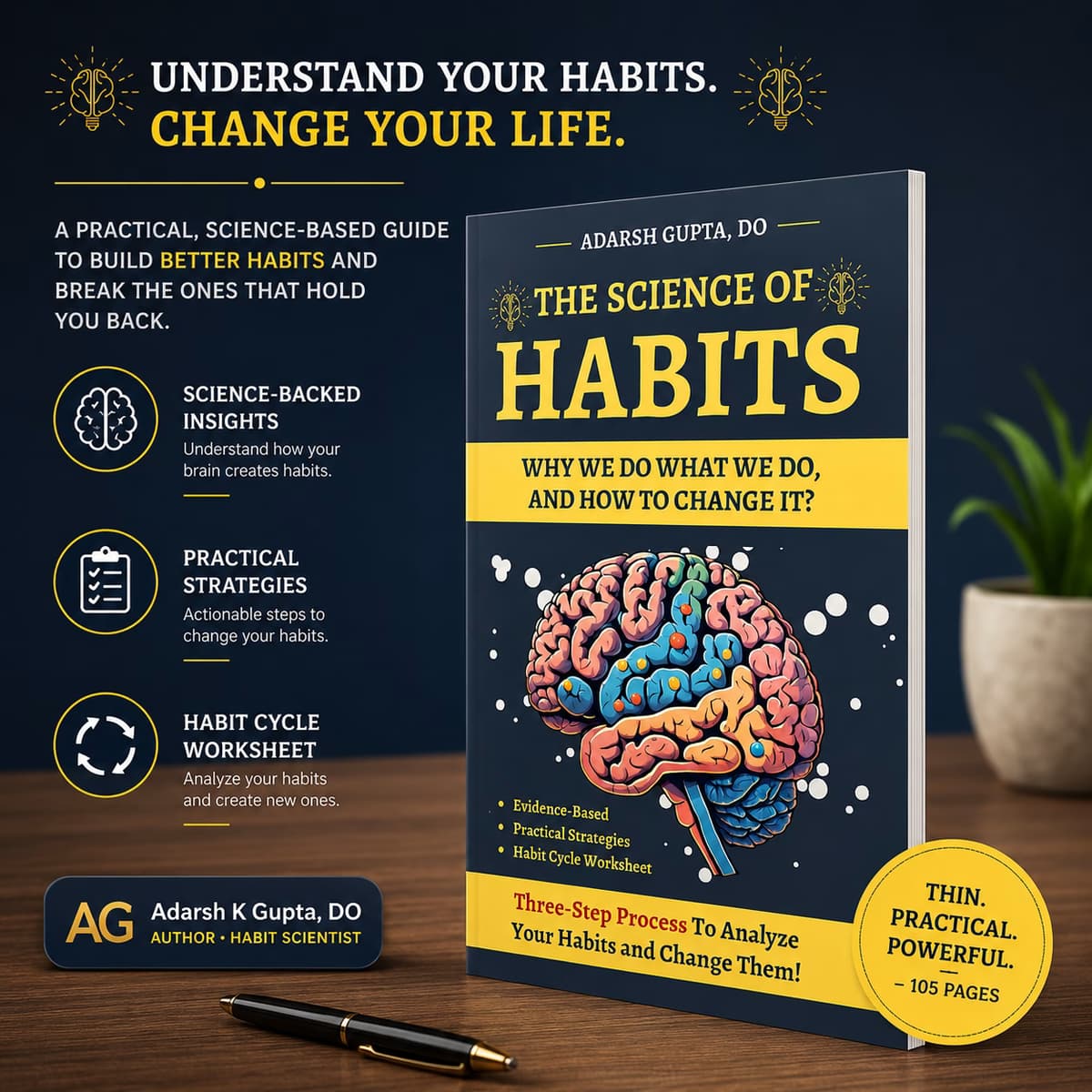
By Dr. Adarsh K. Gupta, DO, MS
The Science of Habits
Why We Do What We Do and How to Change It
Drawing on clinical research and 25+ years of patient practice, Dr. Gupta reveals the four-phase Habit Cycle and how to rewire it for lasting change.
About the Book
Habits run our lives. Research shows that over 40% of our daily actions are habits — automatic behaviors we perform without conscious thought. Yet most people try to change their habits through willpower alone, and most fail.
In The Science of Habits, Dr. Adarsh K. Gupta draws on his 25+ years as a practicing physician and his deep study of behavioral neuroscience to reveal why habits form, persist, and — most importantly — how to change them.
Central to the book is Dr. Gupta's four-phase Habit Cycle: Trigger → Craving → Action → Reward. By understanding each phase, readers can identify exactly where their habit loops break down and apply targeted interventions.
What You'll Learn
- ✓The neuroscience behind habit loops and why willpower alone fails
- ✓How to identify your personal habit triggers
- ✓The Craving-Action gap and how to leverage it
- ✓Why reward timing determines whether a habit sticks
- ✓Clinical strategies Dr. Gupta uses with his patients
- ✓How to build habit stacks for lasting lifestyle change
How is The Science of Habits different from
Atomic Habits and The Power of Habit?
A side-by-side look at how Dr. Gupta's approach compares with the two most-cited habit books on the market.
| Feature | The Science of Habits | Atomic Habits | The Power of Habit |
|---|---|---|---|
| Core Concept | Focuses on why we form habits & how to change them | Tiny changes for big results | Explains why habits form & their impact |
| Scientific Backing | Extensive research & behavioral psychology | Behavioral science & habit stacking | Strong emphasis on neuroscience & case studies |
| Focus on Habit Cycle | Yes, introduces Habit Cycle | No, uses Cue-Craving-Response-Reward | No, uses Cue-Routine-Reward |
| Actionable Framework | Step-by-step guide for habit transformation | Practical but focuses more on habit stacking | Theoretical with some practical insights |
| Emphasis on Personal Transformation | Strong focus on identity & habit evolution | Practical but less on identity transformation | Less personal, more about organizations & society |
| Practical Exercises & Worksheets | Includes habit tracking & self-improvement tools | No dedicated worksheets | No habit tracking worksheets |
| Behavioral Change Strategies | Practical habit-building & breaking techniques | Focuses on small, incremental changes | More of a deep dive into habit science |
| Audience Focus | For self-improvement seekers, professionals & wellness enthusiasts | Broad audience, productivity-focused readers | Readers interested in psychology & business leadership |
Feature
Core Concept
The Science of Habits
Focuses on why we form habits & how to change them
Atomic Habits
Tiny changes for big results
The Power of Habit
Explains why habits form & their impact
Feature
Scientific Backing
The Science of Habits
Extensive research & behavioral psychology
Atomic Habits
Behavioral science & habit stacking
The Power of Habit
Strong emphasis on neuroscience & case studies
Feature
Focus on Habit Cycle
The Science of Habits
Yes, introduces Habit Cycle
Atomic Habits
No, uses Cue-Craving-Response-Reward
The Power of Habit
No, uses Cue-Routine-Reward
Feature
Actionable Framework
The Science of Habits
Step-by-step guide for habit transformation
Atomic Habits
Practical but focuses more on habit stacking
The Power of Habit
Theoretical with some practical insights
Feature
Emphasis on Personal Transformation
The Science of Habits
Strong focus on identity & habit evolution
Atomic Habits
Practical but less on identity transformation
The Power of Habit
Less personal, more about organizations & society
Feature
Practical Exercises & Worksheets
The Science of Habits
Includes habit tracking & self-improvement tools
Atomic Habits
No dedicated worksheets
The Power of Habit
No habit tracking worksheets
Feature
Behavioral Change Strategies
The Science of Habits
Practical habit-building & breaking techniques
Atomic Habits
Focuses on small, incremental changes
The Power of Habit
More of a deep dive into habit science
Feature
Audience Focus
The Science of Habits
For self-improvement seekers, professionals & wellness enthusiasts
Atomic Habits
Broad audience, productivity-focused readers
The Power of Habit
Readers interested in psychology & business leadership
Frequently Asked Questions
Who is this book for?
Anyone who has tried and failed to build good habits or break bad ones. Whether you're dealing with health, productivity, relationships, or mindset — the Habit Cycle applies to every area of life.
Is it based on clinical research?
Yes. Every principle in the book is grounded in peer-reviewed research, plus 25+ years of clinical observations from Dr. Gupta's medical practice.
What formats is it available in?
Kindle, Paperback, and Audiobook — all available on Amazon.
How is this different from Atomic Habits?
The Science of Habits takes a clinical lens — Dr. Gupta applies habit science to medical outcomes and patient behavior change, bringing a physician's perspective that goes beyond behavioral psychology.