The First Autonomous AI Diagnosis: 8 Years of Lessons
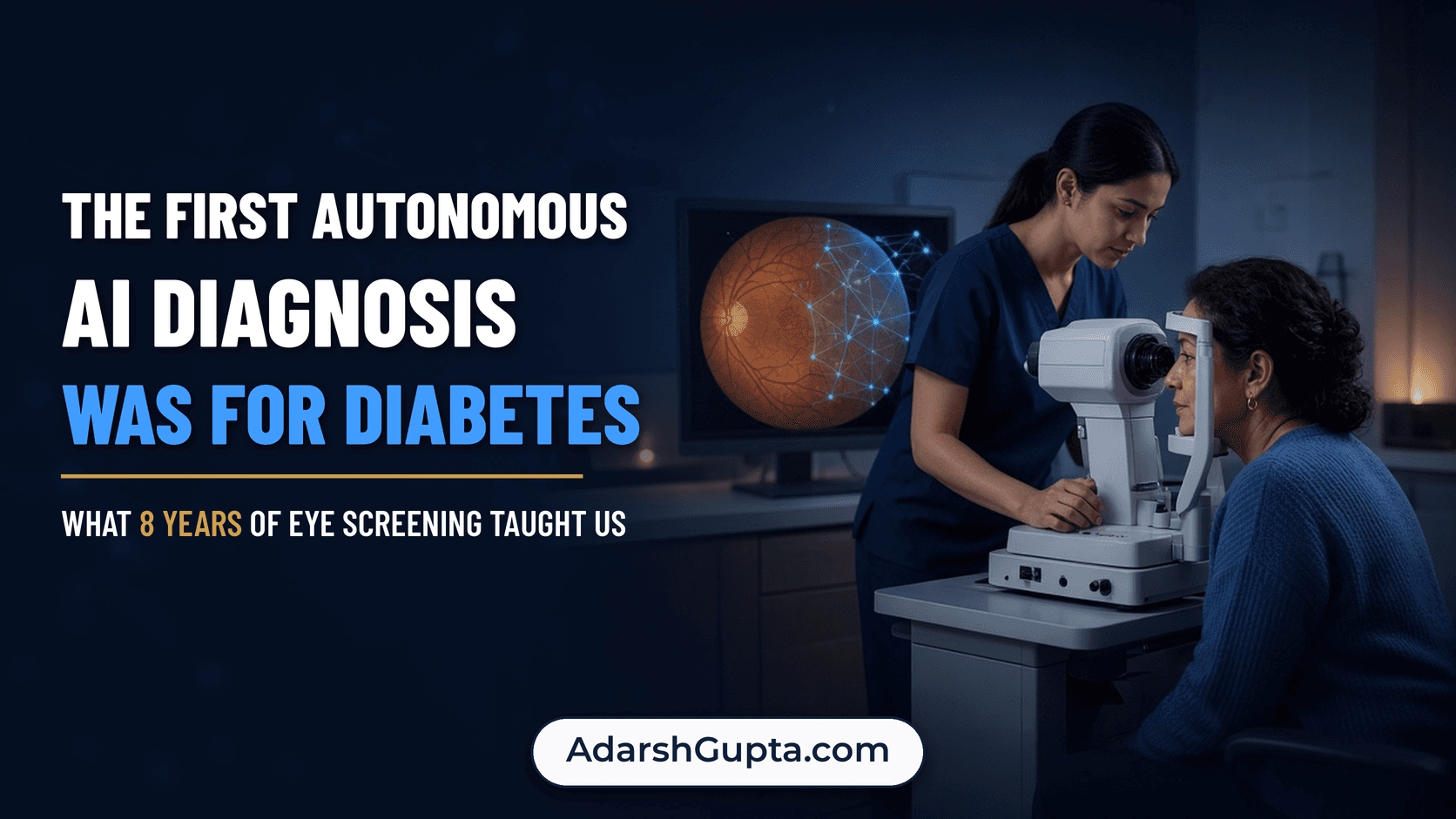
A woman with type 2 diabetes sits down in her primary care office. A medical assistant — not an ophthalmologist, not an optometrist — positions a retinal camera, takes four photographs, and uploads them. About a minute later, the result returns: more than mild diabetic retinopathy detected. Refer to an eye care professional.
No physician read the images. No physician was required to.
That workflow became legal in the United States on April 11, 2018, when the FDA authorized IDx-DR — the first AI system authorized to make a screening decision on its own. It is still the clearest real-world test of what autonomous clinical AI can and cannot do.Today is World Diabetes Day. It is a fitting moment to look back at the device that opened the door — and at what eight years of evidence say about walking through it.
Why diabetic eye screening was the right first test
Diabetic retinopathy is a leading cause of preventable blindness in working-age adults. It is also, in principle, an easy problem to prevent: annual retinal exams catch damage early, and early treatment works.
The problem has never been the medicine. It has been the habit.
About half of U.S. adults with diabetes do not get the recommended annual eye exam — the FDA itself cited roughly 50% when it authorized IDx-DR. The reasons are familiar: a separate appointment, a separate specialist, dilation, time off work, travel, cost. Every extra step in a care pathway is a point where people drop out.
That made diabetic retinopathy an unusually good candidate for autonomous AI:
- A narrow, well-defined question. Is there more-than-mild retinopathy, yes or no?
- A clear action. Positive means refer. Negative means rescreen in a year.
- A real access gap. The screening that patients were not getting could now happen in the office they were already visiting.
What the FDA actually authorized
The details matter, because the authorization was narrower than the headlines.
IDx-DR (later renamed LumineticsCore by its maker, Digital Diagnostics) was authorized through the FDA's De Novo pathway for adults with diabetes who had not previously been diagnosed with diabetic retinopathy. It detects more-than-mild diabetic retinopathy using images from a specific retinal camera. It does not diagnose glaucoma, macular degeneration, or other eye disease. It is not intended for patients with previously diagnosed retinopathy or macular edema, prior eye treatment, or pregnancy.
The pivotal trial was prospective and run in primary care — not in an academic eye clinic. It enrolled 900 patients across 10 primary care sites and reported sensitivity of about 87% and specificity of about 91%, measured against a rigorous reading-center standard. It also produced a usable result for about 96% of participants — a number that turns out to matter.
Two years later, in August 2020, the FDA cleared a second system, EyeArt (Eyenuk), which also detects vision-threatening retinopathy. Other systems have followed. Autonomous retinal screening is no longer a single product. It is a category.
Red Flag #1 — regulation — is not "Is it FDA-cleared?" It is "What exactly was it cleared to do, in whom, and with what equipment?" Autonomous retinal AI is a model case of a precise, bounded indication.Lesson 1: Autonomy changed who carries the liability
Most clinical AI is assistive: it makes a suggestion, and a physician decides. The legal and ethical responsibility stays with the physician.
Autonomous AI breaks that model. If no physician reads the image, who is responsible when the AI misses disease?
Digital Diagnostics took an unusual position early on: the company stated publicly that it accepts liability for the diagnostic output of its autonomous system, and it carries malpractice insurance for that purpose. Whatever one thinks of the business model, it established an important principle.
If a vendor wants its AI to work without a physician in the loop, the vendor should be willing to stand behind the result. A company that markets autonomy but disclaims responsibility is asking clinicians to carry risk they cannot see.That question applies directly to every vendor now describing its tools as "autonomous" or "agentic." Ask who is liable. The answer tells you how much the company actually trusts its own product.
Lesson 2: Payment followed evidence — slowly
For years, a recurring complaint about clinical AI has been the gap between FDA authorization and reimbursement. Over a thousand AI-enabled devices have been authorized; only a small number have dedicated payment pathways.
Autonomous retinal screening is one of the few that crossed that gap. The AMA created a CPT code for autonomous AI retinal analysis (92229), effective January 1, 2021. CMS began paying for it that year through local contractor pricing and set a national rate in 2022. Diabetes quality measures already rewarded completed eye exams, which gave health systems a second reason to adopt.
That took years, and it happened because three things lined up: a clear indication, prospective evidence in the intended setting, and an existing quality gap that payers already cared about.
Reimbursement did not follow the technology. It followed the evidence that the technology closed a gap payers were already measuring.Lesson 3: The lab result is not the clinic result
Accuracy in a trial is necessary. It is not sufficient.
The most instructive cautionary study in this field did not come from a bad algorithm. It came from a good one. When Google Health researchers deployed a well-validated retinopathy model in clinics in Thailand in a research deployment, they published an unusually honest account of what happened. About one in five images (21% in the first six months) were rejected as ungradable — poor lighting, small pupils, inconsistent technique. Slow internet connections delayed results. Some patients, told they would need to travel to a hospital for follow-up because their image could not be read, chose not to go.
The algorithm was accurate. The system around it was not ready.
Red Flag #6 is the gap between trial performance and real-world performance. In autonomous AI, that gap is often not in the model at all. It is in the camera, the lighting, the staff training, the network connection, and the referral pathway.The questions that matter after deployment are operational:
- What percentage of images are ungradable, and what happens to those patients?
- Does a positive result actually lead to an eye exam — or just a referral letter?
- Is performance being monitored over time, across sites and patient groups?
Lesson 4: Screening is only as good as the follow-up
Here is the strongest evidence that autonomous AI can change outcomes — and the clearest warning about where it stops.
In a randomized trial in youth with diabetes aged 8 to 21 (the ACCESS trial, published in 2024), patients offered autonomous AI screening at their diabetes visit completed eye screening at dramatically higher rates than those referred to a separate eye-care appointment. In the AI arm, every participant completed screening; in the usual-care arm, 22% did.
That is what removing a step in the care pathway looks like.
But detection is only the first half of the job. A positive screen means nothing if the patient never sees an eye specialist. In the same trial, 64% of AI-arm participants with an abnormal result completed follow-up with an eye care provider, compared with 22% in the control arm — better with AI, but far from complete.
AI can close the screening gap in a single visit. It cannot, by itself, close the follow-up gap. That still depends on scheduling, transportation, cost, and a human who calls the patient back.This is where the habit lens from The Science of Habits applies. The Trigger is a positive result. The Craving is relief — "I'm handled now." The Action, too often, is nothing. The Reward is avoiding another appointment. A screening program that does not redesign that cycle produces referrals, not treatment.
Lesson 5: Autonomy works when the problem is narrow
Eight years in, autonomous retinal screening remains a success story precisely because of how little it tries to do.
It answers one question, in one population, with one class of imaging device, leading to one action. The failure modes are known. The indication is precise. The output is binary and actionable.
That is a very different proposition from the autonomous AI now being marketed in other areas of medicine: systems that summarize complex histories, suggest diagnoses across many conditions, or act on behalf of clinicians across workflows.
The lesson of the first autonomous AI is not "autonomy works." It is "autonomy works when the question is narrow, the evidence is prospective, the indication is precise, and someone stands behind the result."Most of today's "autonomous" claims meet few of those conditions.
What to ask about any autonomous clinical AI
Use diabetic retinal screening as the benchmark. Before trusting any system that claims to work without a physician in the loop, ask:
- What exact question does it answer? One condition, or many? Binary output, or open-ended?
- What was it cleared for? Population, setting, equipment, and exclusions.
- Was it tested prospectively in the setting where it will be used? Not just on archived images.
- What happens when it cannot produce a result? Ungradable rates and fallback pathways.
- Who is liable for a missed diagnosis? The vendor, the health system, or a clinician who never saw the data?
- How is follow-up guaranteed? Detection without treatment is not care.
- How is performance monitored after deployment? Across sites, devices, and patient groups.
If a vendor cannot answer these as clearly as the first autonomous retinal AI could in 2018, it is not ready to work without a physician.
Frequently Asked Questions
Q: What was the first FDA-authorized autonomous AI diagnostic system?
A: IDx-DR, now called LumineticsCore, developed by Digital Diagnostics. The FDA authorized it through the De Novo pathway in April 2018 to detect more-than-mild diabetic retinopathy in adults with diabetes, without requiring a clinician to interpret the images. It was the first AI system authorized to provide a screening decision on its own.
Q: How accurate is autonomous AI for diabetic retinopathy screening?
A: In its pivotal prospective trial in primary care, IDx-DR showed sensitivity of about 87% and specificity of about 91% for more-than-mild diabetic retinopathy. Other cleared systems, including EyeArt, have reported comparable or higher sensitivity. Real-world performance also depends on image quality, camera technique, and the proportion of images that cannot be graded — which is why post-deployment monitoring matters as much as trial results.
Q: Does autonomous AI replace an eye exam by an ophthalmologist or optometrist?
A: No. It is a screening tool. A negative result supports rescreening in a year. A positive result means the patient needs a full eye examination by an eye care professional. The AI also does not evaluate other eye conditions such as glaucoma or macular degeneration, so it is not a substitute for comprehensive eye care.
Q: Who is responsible if an autonomous AI misses diabetic retinopathy?
A: This depends on the product and the contracts involved, and the law is still developing. Digital Diagnostics has publicly stated that it accepts liability for its autonomous system's diagnostic output. That position is not universal across vendors. Health systems and clinicians should ask every autonomous AI vendor directly who carries liability for a missed diagnosis.
Q: What does autonomous retinal screening teach us about newer "autonomous" or "agentic" AI tools?
A: It shows the conditions under which autonomy has worked: a narrow, well-defined question, prospective validation in the real clinical setting, a precise regulatory indication, a clear next action, and a vendor willing to stand behind the result. Many newer tools described as autonomous perform broad, open-ended tasks and have not met those conditions. The first autonomous AI should be the benchmark, not the exception.
Sources
- U.S. Food and Drug Administration. De Novo decision summary: IDx-DR (DEN180001). April 11, 2018. accessdata.fda.gov
- U.S. Food and Drug Administration. FDA permits marketing of artificial intelligence-based device to detect certain diabetes-related eye problems. April 11, 2018. Press release
- Abràmoff MD, Lavin PT, Birch M, Shah N, Folk JC. Pivotal trial of an autonomous AI-based diagnostic system for detection of diabetic retinopathy in primary care offices. npj Digital Medicine. 2018. nature.com
- U.S. Food and Drug Administration. 510(k) K200667: EyeArt (Eyenuk). August 3, 2020. accessdata.fda.gov
- Abràmoff MD, et al. Lessons learned about autonomous AI: finding a safe, efficacious, and ethical path through the development process. American Journal of Ophthalmology. 2020. ajo.com
- Centers for Medicare & Medicaid Services. MLN Matters MM12071: CY 2021 Physician Fee Schedule final rule summary (CPT 92229). cms.gov
- Beede E, et al. A human-centered evaluation of a deep learning system deployed in clinics for the detection of diabetic retinopathy. CHI 2020. research.google
- Wolf RM, Channa R, Liu TYA, et al. Autonomous artificial intelligence increases screening and follow-up for diabetic retinopathy in youth: the ACCESS randomized control trial. Nature Communications. 2024. nature.com
Dr. Adarsh K. Gupta, DO, MS is a physician and clinical AI evaluator, a Cochrane Associate Editor, and the author of The Science of Habits, where the Habit Cycle (TCAR) framework was first developed. He has 25+ years of clinical experience. Get his free Clinical AI Red Flags guide, and subscribe to the Clinical AI Brief for biweekly analysis of clinical AI tools, safety, and adoption.