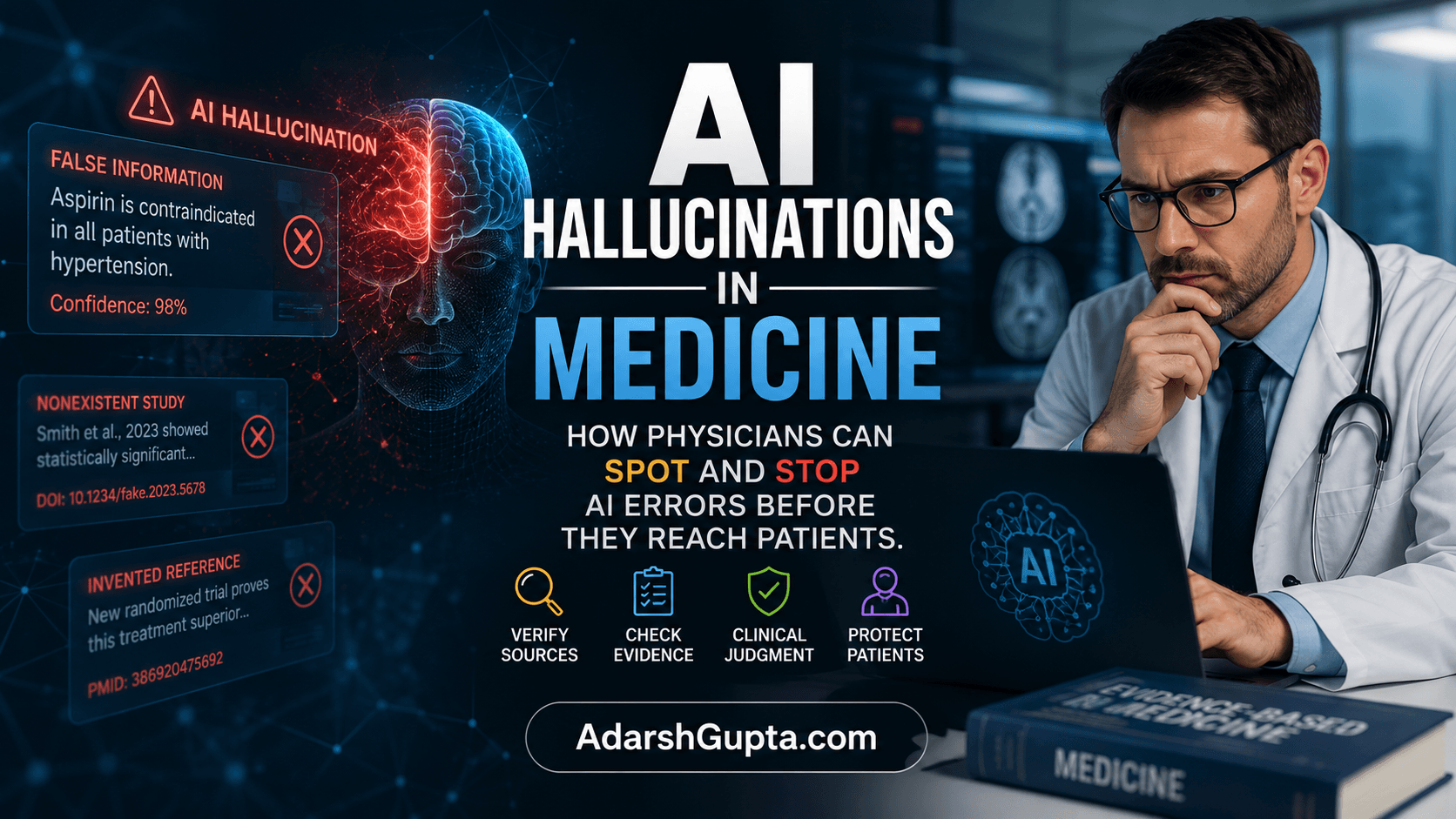
AI Hallucinations in Medicine: How Physicians Can Spot and Stop AI Errors Before They Reach Patients
There is a moment every physician will eventually face: you ask an AI tool a clinical question, and the answer sounds completely right. The drug name is correct. The dosage is plausible. The rationale is fluent, confident, and well-organized.
And it is wrong.
Not wrong in a way that triggers your instinct. Wrong in a way that only becomes visible when you check the primary source - the package insert, the trial data, the guideline. Wrong with the full authority of a confident colleague who has never once second-guessed themselves.
This is an AI hallucination. And as artificial intelligence moves from research papers into real clinical workflows, it is the problem that no one in hospital administration is talking about loudly enough.
What Is an AI Hallucination - in Plain Clinical Terms?
The term "hallucination" comes from AI research. It describes outputs that are fluent, grammatically correct, and internally consistent - but factually false or unsupported by evidence.
Large language models (LLMs) - the technology behind tools like ChatGPT, ambient clinical documentation assistants, and AI-powered diagnostic support - do not "know" facts the way a textbook does. They predict the most statistically likely next word, given everything they were trained on. When training data is incomplete, outdated, or ambiguous, the model fills in the gap with something plausible-sounding.
In creative writing, this is a feature. In clinical medicine, it is a patient safety event waiting to happen.
Examples of AI hallucinations in clinical contexts:
- Citing a clinical trial that does not exist, with accurate-sounding authors, journal names, and p-values
- Recommending a drug interaction that has no pharmacological basis - or missing one that does
- Generating a clinical note that documents findings the physician never recorded
- Providing a dosing calculation that is off by a factor of ten, formatted with authoritative precision
- Summarizing a patient chart and omitting a critical allergy or contraindication
These are not edge cases. A 2024 study published in JAMA Internal Medicine found that LLMs hallucinated medical references at rates between 30-50% depending on the query type. A 2025 audit of AI-generated discharge summaries found clinically significant errors in 1 in 5 documents reviewed.
Why Physicians Are Uniquely Vulnerable
The same cognitive shortcuts that make experienced physicians efficient also make them susceptible to AI errors.
Pattern recognition works against you here. When an AI output matches the expected structure of a correct answer - organized, confident, detailed - your brain processes it as credible. This is the same heuristic that makes you trust a well-formatted consult note more than a scrawled sticky note, regardless of accuracy.
Cognitive load amplifies the risk. The moments when physicians are most likely to reach for an AI tool - high census days, overnight shifts, complex multi-morbidity patients - are exactly the moments when critical appraisal is hardest. Fatigue degrades the very scrutiny that would catch an error.
Calibration mismatch is the core problem. Humans are reasonably good at detecting uncertainty when it is signaled - a colleague who says "I think it's X, but you should check" prompts verification. AI tools almost never signal uncertainty appropriately. They present a fabricated citation with the same confidence as an established guideline. There is no tone of voice, no hesitation, no "I'm not sure about this one."
This is not a technology problem that will be solved in the next software update. It is a structural feature of how these models work.
A Framework for Clinical AI Evaluation: The TRACE Method
After 25 years in clinical practice and the last several years studying the intersection of AI and medicine, I have developed a practical framework I use - and teach - for evaluating AI outputs before acting on them. I call it TRACE.
T - Traceable
Can you trace the claim to a primary source?
Any clinical recommendation, drug fact, or diagnostic criterion that an AI generates should be traceable to a guideline, a trial, or a package insert. If the AI cites a source, verify it exists. If it does not cite a source, treat it as unverified opinion until you can confirm it independently.
Practical rule: Never act on an AI-generated clinical fact you cannot trace in under 60 seconds. If it takes longer than that to verify, the AI has not actually saved you time - it has added risk.
R - Reasonable Under Clinical Scrutiny
Does this recommendation make sense given the full clinical picture?
AI tools are trained on population-level data. They are systematically weaker at the edges of clinical presentations - rare diseases, complex polypharmacy, atypical demographics, patients who do not fit the training distribution. When the AI's output conflicts with your clinical instinct, that conflict is information. Do not dismiss it.
Practical rule: Any AI recommendation that surprises you - positively or negatively - requires a second verification step before implementation.
A - Auditable Output
Is there a record of what the AI produced, and who acted on it?
This is less about catching errors in the moment and more about the system-level infrastructure that makes AI use safe at scale. Clinical AI outputs should be documented, attributed, and retained. If an adverse event occurs, the question "what did the AI say, and who reviewed it?" must be answerable.
Practical rule: Do not use AI tools in clinical settings that have no audit trail. This is a governance requirement, not a preference.
C - Calibrated Confidence
Is the AI expressing appropriate uncertainty?
A well-designed clinical AI tool should communicate confidence levels - flagging when a query falls outside its reliable range, when evidence is limited, or when the question requires human judgment. Tools that express uniform confidence regardless of query complexity are not safe for unsupervised clinical use.
The gold standard for expressing evidence certainty in medicine is the GRADE framework (Grading of Recommendations, Assessment, Development and Evaluations). GRADE is explicit that certainty ratings attach to a specific clinical question and a specific outcome - not to a study or a paper in isolation. An AI tool that does not apply this distinction is not calibrated; it is confident by default.
Practical rule: Before deploying any AI tool in your practice, deliberately test it with questions you know have uncertain or contested answers. How it handles uncertainty tells you more than how it handles easy questions.
E - Expert-Verified Before Action
Has a qualified human reviewed this output before it affects patient care?
This is the most fundamental principle, and the one most at risk as workflow pressures push toward AI autonomy. The current state of clinical AI - regardless of marketing claims - does not justify removing the physician from the decision loop for consequential clinical actions.
Practical rule: Treat AI output as a draft, not a decision. It is the starting point for your clinical reasoning, not the conclusion.
What Hospitals Are Getting Wrong Right Now
Hospital systems are deploying AI tools at a pace that outstrips their ability to evaluate them. Several patterns are emerging that concern me as both a clinician and someone who studies this space:
Vendor-provided validation is not independent validation. When a hospital signs a contract with an AI vendor, the validation data presented during procurement is almost always generated by the vendor. Independent, site-specific validation - testing the tool against your patient population, your EHR, your workflows - is rare and expensive. Most hospitals are not doing it.
Physicians are not being trained; they are being informed. There is a meaningful difference between handing physicians a one-page FAQ about a new AI tool and training them to critically evaluate AI outputs. The former is a liability protection exercise. The latter is patient safety work.
The "FDA cleared" label creates false security. FDA clearance for AI/ML medical devices (under the 510(k) pathway) evaluates a device against a predicate - it does not guarantee accuracy, freedom from hallucination, or appropriateness for your specific patient population. A cleared AI tool can still produce clinically dangerous outputs.
Practical Steps for Physicians Today
You do not need to wait for your hospital's AI governance committee to act. Here is what you can do right now:
-
Establish a personal verification habit. For every AI-generated clinical recommendation you use, confirm one primary source. Every time. Build it into your workflow before the pressure to skip it becomes normalized.
-
Test your tools before you trust them. Before relying on any AI tool clinically, spend 30 minutes deliberately trying to break it. Ask it questions you know the answers to. Ask it about rare presentations, unusual drug interactions, off-label uses. See how it handles uncertainty.
-
Document your AI use. Even informally - a note in the chart that AI-assisted documentation was reviewed and verified by the treating physician. This is protection for you and transparency for your patient.
-
Push back on autonomous workflows. If your administration is moving toward AI-generated notes that go unreviewed, AI-initiated orders, or AI-generated patient communications without physician sign-off, that is a patient safety concern worth raising formally.
-
Learn to read the confidence signal or its absence. The best AI tools tell you when they are uncertain. If your tool never expresses uncertainty, that is not a sign of accuracy. It is a sign of poor calibration.
The Physician's Role in the Age of Clinical AI
I want to be clear about something: I am not arguing against AI in medicine. Used correctly - with appropriate validation, physician oversight, and honest communication about limitations - AI tools can reduce documentation burden, surface relevant information faster, and support better decisions.
But "correctly" is doing enormous work in that sentence.
The promise of clinical AI is real. The risk of deploying it without a framework for evaluating its outputs is equally real. Physicians are uniquely positioned to close that gap - not because we are technologists, but because we understand what a wrong answer looks like when a patient is in front of us.
The question is whether we will engage with that responsibility proactively, or whether we will wait until a high-profile adverse event forces the conversation.
Twenty-five years of clinical practice has taught me one thing with certainty: the time to build the safety culture is before the near-miss, not after it.
Frequently Asked Questions
Q: Are AI hallucinations in medicine common, or is this overhyped?
A: They are common enough to be a genuine patient safety concern, but the risk is manageable with the right workflows. Studies suggest error rates of 20-50% in unverified AI outputs, depending on query type and tool. The risk is highest in complex, nuanced clinical scenarios - exactly the ones where physicians are most tempted to rely on AI.
Q: Which clinical AI tools are safest to use?
A: Safety depends heavily on the clinical context and how the tool is integrated into your workflow, not just the tool itself. In general, tools with transparent confidence scoring, clear citations, independent validation data, and physician-in-the-loop design are safer than those without. Ask vendors for site-specific validation data - not just aggregate accuracy metrics.
Q: What is CertaintyGrade, and how does it relate to this?
A: CertaintyGrade is a GRADE-based evidence-appraisal and teaching platform built around a single methodological principle: certainty belongs to a clinical question, not to a paper.
The problem with most AI-generated clinical recommendations is that they inherit confidence from whatever sources they were trained on - without ever asking whether that evidence actually answers your specific question for your specific patient population. CertaintyGrade fixes that at the source.
The platform has three tools. Assess runs a true GRADE certainty rating on a body of evidence against a question you define - you get a transparent, citation-backed certainty rating for that specific question, not a badge borrowed from a paper. Journal Club runs structured pro/con evidence debates with AI-assisted worksheets and a moderator synthesis - all student-validated, nothing auto-published. Learn is a free, interactive GRADE methodology tutorial for anyone who needs to understand the framework before they need the tool.
If the TRACE framework in this article describes how physicians should think about AI output, CertaintyGrade is the infrastructure that makes that standard operationalizable at scale. Learn more at certaintygrade.com.
Q: Will AI hallucinations get better as models improve?
A: Yes - newer models hallucinate less than older ones. But "less" is not "never," and the improvement curve is not linear. More capable models can also produce more convincingly wrong outputs, which can make errors harder to catch. The need for physician verification does not disappear as models improve; the nature of the errors changes.
Q: What should I do if I catch an AI error before it reaches a patient?
A: Document it. Report it through whatever adverse event or near-miss reporting system your institution uses. Clinical AI errors that are caught are valuable data - they help identify which query types and clinical scenarios are highest risk, and they create the institutional record needed to improve tools and training over time.
Dr. Adarsh K. Gupta, DO, MS is a physician with 25+ years of clinical experience and the author of The Science of Habits. He is a Clinical AI Strategist and the founder of CertaintyGrade, a GRADE-based evidence-appraisal and teaching platform that rates clinical evidence certainty against a specific question - not a paper. Follow him at adarshgupta.com.