
⚡ Key Takeaways
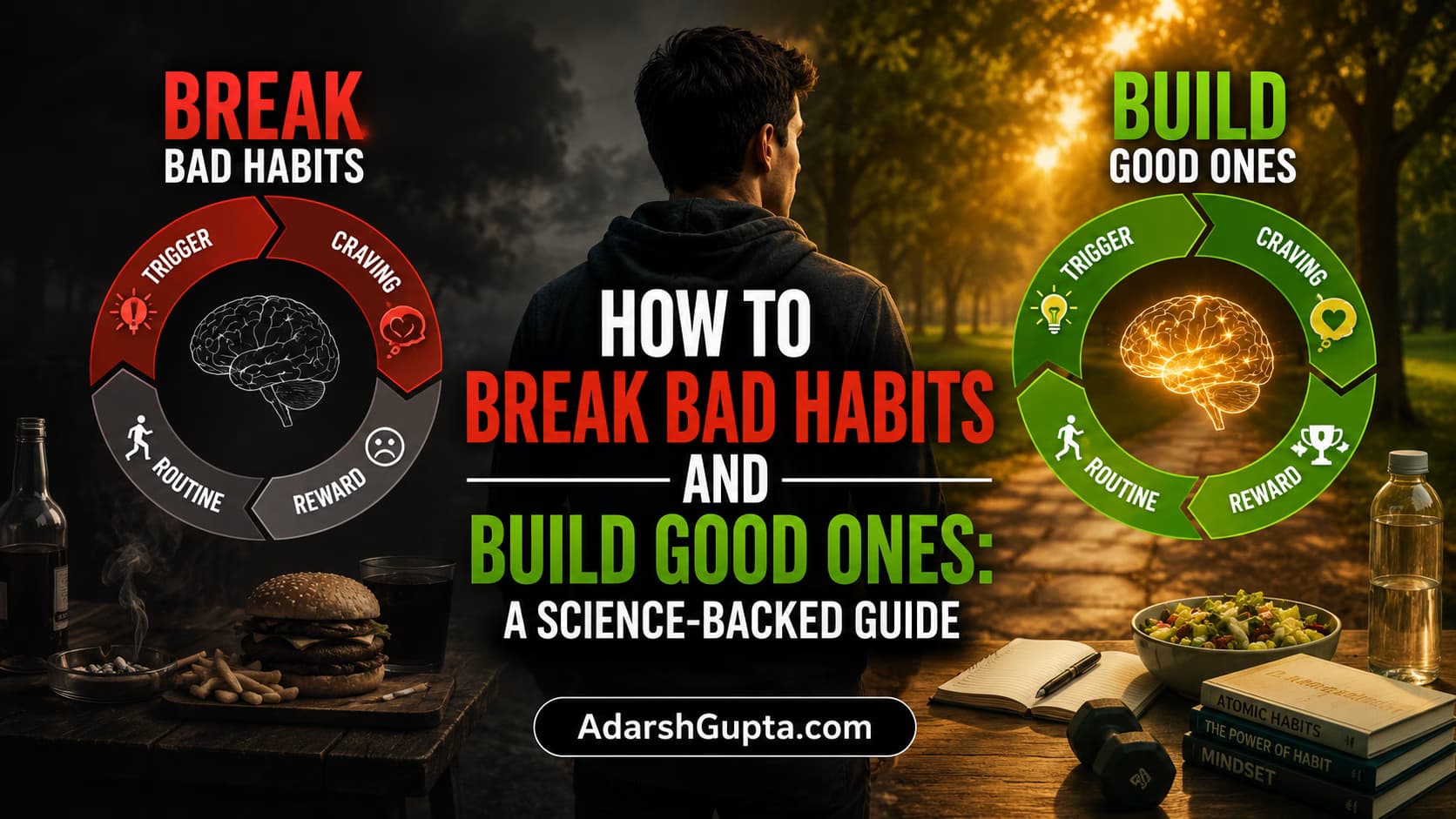
- Breaking bad habits isn’t about willpower — it’s about understanding and disrupting the four-step Habit Cycle: Trigger → Craving → Action → Reward.
- The most effective strategy is replacing a bad habit’s routine with a healthier one — not simply trying to eliminate it.
- Reducing environmental friction is often more powerful than motivation alone.
- Good habits are built through small starts, habit stacking, and consistent reward — not through dramatic overhauls.
- Research suggests 66 days (not 21) is the average time to form a new habit — patience and consistency matter more than perfection.
Why Breaking Bad Habits Is Harder Than It Looks
Most attempts to break bad habits fail for the same reason: they rely on willpower. Willpower is a finite resource that depletes throughout the day — which is why the same person who makes healthy choices in the morning often makes poor ones by evening. Research in behavioral psychology consistently shows that sustainable habit change isn’t a matter of motivation or discipline. It’s a matter of strategy.
Understanding why a habit forms — and precisely where in that process it can be interrupted — is what separates people who successfully break bad habits from those who stay stuck in the same cycles. The framework that best explains this is the Habit Cycle.
How Habits Actually Work: The Habit Cycle
Every habit — good or bad — follows the same four-step neurological loop. This framework, explored in depth in The Science of Habits: Why We Do What We Do and How to Change It by Dr. Adarsh Gupta, DO, is called the Habit Cycle:
- Trigger: A specific cue — internal (stress, boredom, hunger) or external (a location, a time of day, a person) — that initiates the habit sequence.
- Craving: The psychological urge or anticipation that the habit will produce a desired feeling. The craving is what drives the behavior — not the behavior itself.
- Action: The habitual behavior: the scroll, the snack, the cigarette, the procrastination.
- Reward: The outcome that satisfies the craving and tells the brain to repeat this sequence next time the same trigger appears.
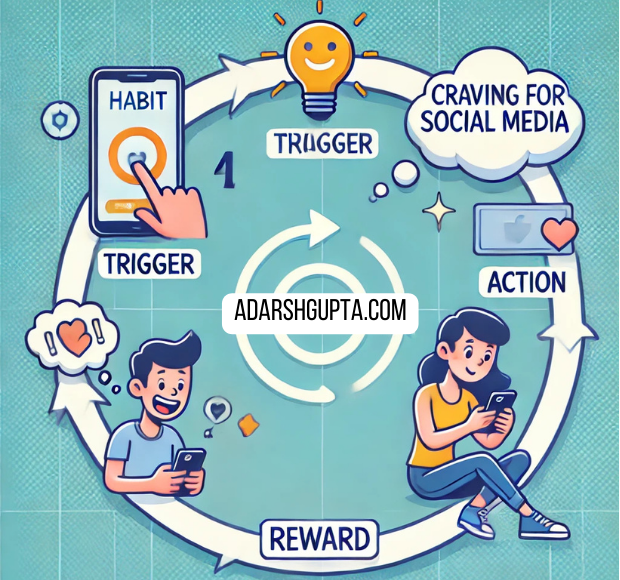
To break a bad habit, the cycle must be disrupted — ideally at the Trigger or Action stage. To build a good habit, a new cycle must be reinforced until the brain automates it. Both processes use the same mechanism: the brain’s basal ganglia, which stores habitual behaviors as efficient neural pathways that operate largely outside conscious awareness.
This is why telling yourself to “just stop” rarely works. The Trigger still fires, the Craving still arises — and without a replacement Action, the brain returns to its default pathway.
Research Note: A 2006 Duke University study estimated that more than 40% of daily human behaviors are habits — automatic actions performed with little conscious deliberation. The same neural systems that make habits efficient also make them resistant to change through willpower alone.
How to Break Bad Habits: 5 Evidence-Based Strategies
1. Identify the Trigger First
Before anything else, the specific trigger driving the habit needs to be identified. Many people try to change their behavior without ever examining what triggers it, which is like trying to fix a leak by mopping the floor.
For one week, when the urge to engage in the habit arises, pause and note:
- When does it happen? (time of day)
- Where are you? (location)
- What were you doing just before? (preceding activity)
- How were you feeling? (emotional state)
- Who was present? (social context)
A pattern will emerge within a few days. Late-night social media scrolling, for example, is often triggered by the transition from active evening activities to lying in bed — not by a genuine desire to check social media. Identifying this makes the trigger visible and therefore interruptible.
2. Replace the Routine — Don’t Just Eliminate It
Attempting to eliminate a behavior without replacing it leaves a void in the Habit Cycle. The Trigger still fires, the Craving still arises, but now there’s no outlet — which creates psychological tension that the brain eventually resolves by returning to the old habit.
The more effective approach: keep the Trigger and the Reward, but substitute a healthier Action that delivers a similar reward.
- If stress triggers emotional eating → the craving is for comfort. Replace the snack with a 5-minute walk or a breathing exercise — both deliver genuine stress relief.
- If boredom triggers phone scrolling → the craving is for stimulation. Replace it with a physical book, a podcast, or a short creative task.
- If fatigue triggers overconsumption of caffeine → the craving is for energy. Replace the third coffee with a 10-minute movement break or a glass of cold water.
The replacement works best when it genuinely satisfies the same underlying craving — not just when it’s theoretically “healthier.”
3. Increase Friction for Bad Habits, Reduce It for Good Ones
Behavioral economists call this “choice architecture” — designing the environment so that the desired behavior is the path of least resistance. This works because most habits are not driven by deep desire but by convenience and proximity.
To break bad habits, make them harder to access:
- Delete social media apps from the phone’s home screen (adding even 20 seconds of friction reduces use dramatically)
- Keep junk food out of the house entirely — the urge rarely survives a trip to the store
- Put the TV remote in a drawer across the room
- Leave the phone in another room during focused work
To build good habits, make them easier to start:
- Set workout clothes out the night before
- Keep a water bottle on the desk
- Put the book on the pillow instead of the phone charger
- Prep healthy foods so they’re as convenient as processed ones
A Stanford behavioral design lab study found that reducing the effort required to perform a behavior by even two minutes significantly increased the likelihood of follow-through. Environmental design is often more reliable than motivation.
4. Use If-Then Implementation Intentions
An implementation intention is a pre-committed plan in the format: “If , then I will .” Research by psychologist Peter Gollwitzer and colleagues found that people who form specific if-then plans are 2–3 times more likely to follow through than those who rely on general intentions.
Examples:
- If I feel stressed after work, then I will change into workout clothes immediately instead of sitting on the couch.
- If I reach for my phone in bed, then I will put it face down and pick up my book instead.
- If I feel the urge to smoke after a meal, then I will take a 10-minute walk around the block first.
The if-then format works because it pre-loads the decision — the brain doesn’t have to deliberate in the moment when willpower is typically at its lowest. The response becomes almost as automatic as the habit it’s replacing.
5. Use Accountability and Consistent Tracking
External accountability significantly increases follow-through on behavior change goals. Telling a specific person about a habit change goal — with a defined timeline and check-in — has been shown to be more effective than internal commitment alone.
Habit tracking apps (Habitica, Streaks, or even a simple paper calendar with X marks) create a “don’t break the chain” effect — the visual streak becomes its own reward and motivation. The goal isn’t perfection; it’s maintaining awareness of patterns and celebrating consistency.
How to Build Good Habits That Last: 5 Strategies
1. Start Smaller Than Feels Necessary (Micro-Habits)
The biggest barrier to starting a new habit is the perceived size of the commitment. The solution is to make the starting action so small it feels almost trivial.
- Want to exercise daily? Commit to 5 minutes — not 30.
- Want to read more? Start with one page per night.
- Want to meditate? Begin with two deep breaths in the morning.
The goal of a micro-habit isn’t the output — it’s establishing the neural pathway and the identity of being someone who does this thing. Once the habit is automatic, duration naturally increases. Starting too big leads to the all-or-nothing thinking that causes most habit attempts to fail within the first two weeks.
2. Use Habit Stacking
Habit stacking — attaching a new habit to an existing, automatic one — is one of the most effective techniques for habit formation because it borrows the Trigger already built into an existing routine.
The formula: “After I , I will .”
- After I pour my morning coffee, I will write down one intention for the day.
- After I brush my teeth at night, I will do 10 push-ups.
- After I sit down at my desk, I will spend the first 5 minutes on the most important task before checking email.
The existing habit serves as the automatic Trigger. The brain doesn’t need to remember — the new behavior gets pulled along with the old one.
3. Design the Environment for Success
Just as environment design can break bad habits by adding friction, it can build good ones by reducing it. The goal is to make the default option the healthy one.
- Keep a bowl of fruit on the counter instead of in the refrigerator
- Set a glass of water next to the bed the night before
- Keep a journal on the kitchen table, not buried in a drawer
- Store workout equipment where it’s visible, not in a closet
Research on food environment design consistently shows that people eat what’s convenient and visible — not necessarily what they prefer. The same principle applies to nearly every habit domain.
4. Reward Progress to Reinforce the Cycle
The Reward stage of the Habit Cycle is what tells the brain to repeat the behavior. For new habits, the natural reward often doesn’t feel meaningful yet — which is why manufactured rewards in the early stages are a legitimate strategy, not a sign of weakness.
- Celebrate completing a week of consistent exercise with a relaxing evening activity
- Mark each completed habit day with a visible X on a calendar (visual reinforcement works)
- Pair an enjoyable activity with the new habit — listen to a favorite podcast only during workouts
Over time, the habit itself produces its own reward (improved energy, better sleep, sense of accomplishment) — but external reinforcement bridges the gap during the early formation period.
5. Track Habits and Review Weekly
Tracking creates awareness, and awareness is the first step in maintaining consistency. A simple habit tracker — whether a dedicated app or a paper journal — makes patterns visible and provides a feedback loop.
A weekly 5-minute review of habit completion rates helps identify which triggers are working, which replacements are sticking, and where adjustments are needed. This prevents the slow drift that happens when habits are assumed to be automatic before they actually are.
How Long Does It Actually Take to Break or Form a Habit?
The widely cited “21 days to form a habit” figure comes from a 1960s observation by a plastic surgeon — not behavioral science research. A more rigorous 2010 study by Phillippa Lally and colleagues at University College London found that habit automaticity took anywhere from 18 to 254 days, with an average of 66 days — and that missing a single day had minimal impact on long-term habit formation.
What this means practically:
- Expect the first 2–3 weeks to feel effortful — this is normal, not failure
- Around weeks 4–6, the behavior begins to feel more automatic
- By weeks 8–12, consistent habits typically require significantly less conscious effort
- Missing a day is not a reason to restart — consistency over months matters far more than perfection day-to-day
To identify which stage of the Habit Cycle is currently the biggest obstacle — Trigger, Craving, Action, or Reward — the free Habit Cycle Score Quiz takes about 3 minutes and delivers a personalized result showing exactly where to focus.
— Published on AdarshGupta.com | Educational content by Dr. Adarsh Gupta, DO — Author of The Science of Habits and Seven Secrets to a Healthier You
Frequently Asked Questions
How do you break a bad habit for good?
The most effective way to break a bad habit for good is to identify its Trigger, understand the underlying Craving it satisfies, and replace the Action with a healthier behavior that delivers a similar reward. Simply trying to eliminate a habit without replacing it tends to fail because the Trigger and Craving remain active. Combining habit replacement with environmental friction (making the bad habit harder to access) and if-then planning gives the strongest and most durable results according to behavioral research.
How long does it take to break a bad habit?
Research suggests habit change takes significantly longer than the popular “21 days” claim. A 2010 University College London study found that forming new automatic behaviors takes an average of 66 days, with a range of 18 to 254 days depending on the complexity of the behavior and individual factors. For breaking a well-established bad habit, expect 8–12 weeks of consistent effort before the new pattern feels genuinely automatic. Missing occasional days does not reset the process — consistency over months matters more than daily perfection.
What is the habit cycle and how does it help break bad habits?
The Habit Cycle is a four-step neurological loop: Trigger → Craving → Action → Reward. Every habit — good or bad — follows this sequence. Understanding the cycle helps break bad habits because it reveals exactly where the behavior can be interrupted. The most effective intervention points are the Trigger (reducing exposure to it or changing the environment) and the Action (replacing it with a healthier behavior that satisfies the same Craving). Without understanding the cycle, most habit change attempts target the Action alone while leaving the Trigger and Craving untouched.
Why does willpower fail at breaking bad habits?
Willpower relies on the prefrontal cortex — the conscious decision-making part of the brain. Habitual behaviors, however, are stored in the basal ganglia and operate largely outside conscious awareness. When a Trigger fires, the habit response activates automatically before the conscious mind fully engages. Additionally, willpower is a depletable resource — it decreases with stress, fatigue, and decision fatigue throughout the day, which is why most habit slips happen in the evening. Strategy-based approaches (environment design, if-then planning, habit replacement) work because they operate at the level of the habit loop itself, not against it.
What is habit stacking and does it work?
Habit stacking is the technique of attaching a new habit to an existing automatic one, using the format: “After I , I will .” It works because the existing habit provides a reliable, built-in Trigger for the new behavior — removing the need to remember to start it. Research on implementation intentions shows this approach significantly increases follow-through compared to vague intentions. Common examples: doing push-ups after brushing teeth, writing a daily intention after pouring morning coffee, or meditating after arriving at a desk. The key is choosing an anchor habit that happens consistently at the desired time.
Can you form good habits and break bad ones at the same time?
Yes — and in many cases the two processes support each other. When a new good habit is designed to replace the routine of a bad one (using the same Trigger and delivering a similar Reward), both changes happen simultaneously. However, attempting to overhaul multiple unrelated habits at once tends to dilute focus and reduce success rates. Research on behavior change generally supports working on one to two habits at a time until they reach automaticity (around 8–10 weeks), then adding the next one — a process called “habit layering.”
What are examples of micro-habits that are easy to start?
Micro-habits are intentionally small starting versions of a desired behavior — small enough that motivation is never a barrier to beginning. Examples: one page of reading per night, two minutes of stretching after waking up, writing a single sentence in a journal, drinking one glass of water before coffee, doing five push-ups after brushing teeth, taking three deep breaths before a stressful task. The goal is establishing the behavioral pathway and the associated identity, not the output. Once the micro-habit is automatic — typically within 4–6 weeks — the behavior naturally expands.