
Most people believe that change begins with motivation.
But motivation is fleeting.
Lasting transformation—whether in health, productivity, or personal growth—begins with understanding the science of habit formation.
This principle is the foundation of my book, The Science of Habits: Why We Do What We Do and How to Change It, and it is the guiding framework behind the relaunch of my podcast, Master Your Habits, Health & Life.
This article is the official companion to Episode 1 (Relaunch Episode). It reintroduces the podcast, clarifies its mission, and establishes a unified framework that will anchor all future content on AdarshGupta.com.
Why the Science of Habit Formation Matters
We live in an age of unlimited information.
You already know:
- What foods are healthy
- That movement matters
- That sleep is essential
- That stress affects your health
Yet knowing what to do rarely leads to lasting change.
The missing link is not education—it’s behavioral wiring.
Habits are the brain’s efficiency mechanism. Once a behavior becomes habitual, it runs with minimal conscious effort. That’s why habits—good or bad—are so powerful.
When you understand the science of habit formation, you stop relying on willpower and start designing behaviors that work with your brain instead of against it.
The Habit Cycle: The Core Framework from The Science of Habits
In The Science of Habits, behavior change is explained through a clear and practical framework called The Habit Cycle.
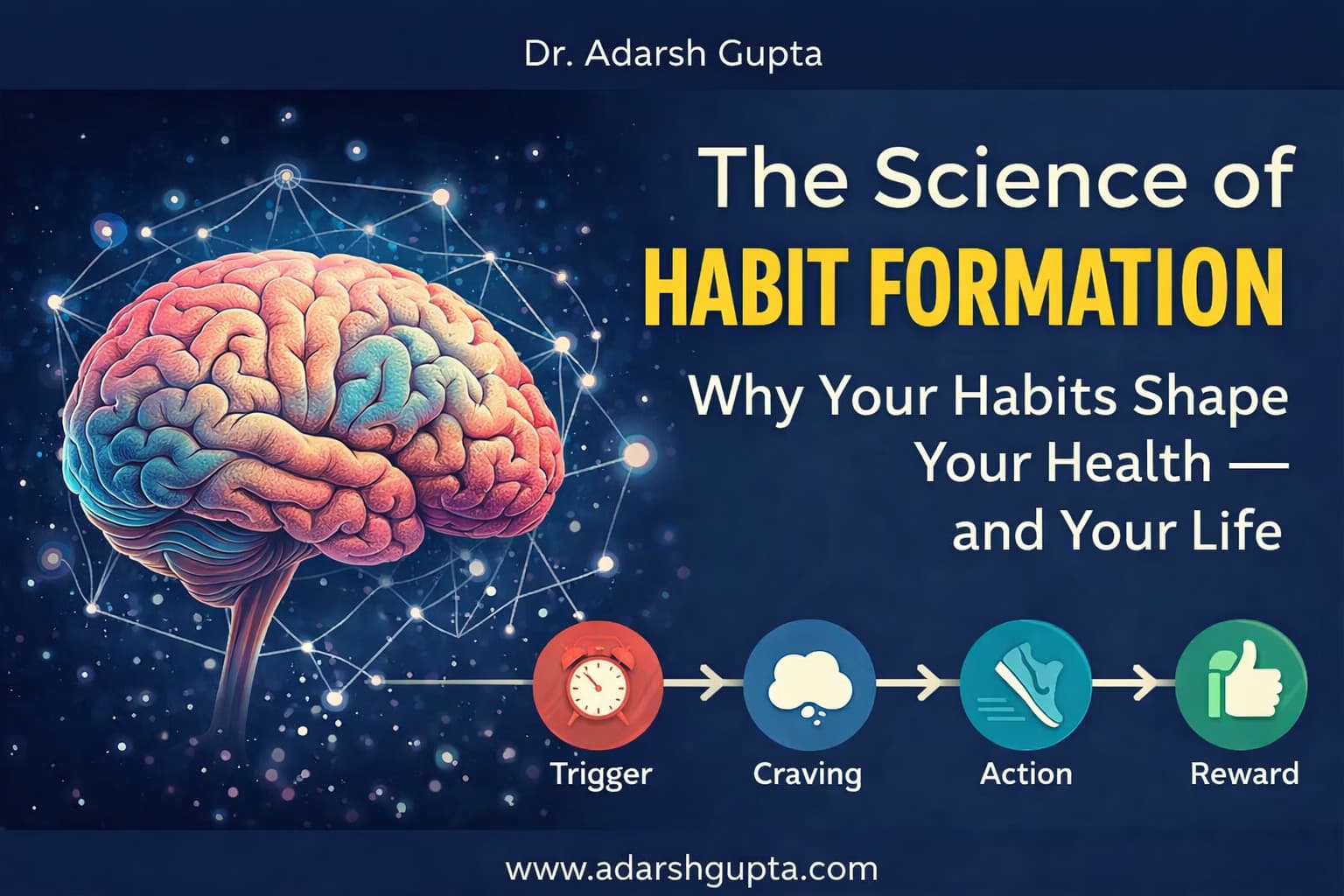
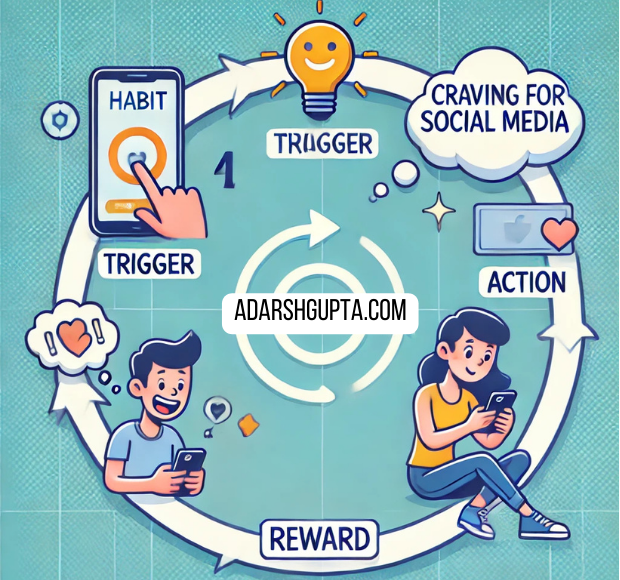
Unlike vague or oversimplified models, the Habit Cycle describes a four-step process that etches behaviors into our neural pathways:
1. Trigger
A trigger initiates the habit. It can be:
- A time of day
- A location
- An emotional state
- A sensory cue (such as a smell or sound)
For example, the smell of coffee in the morning can automatically cue the desire to drink it—often before conscious thought occurs.
2. Craving
A craving is the psychological response to the trigger.
This is where anticipation forms. The brain begins to desire the outcome associated with the habit:
- Comfort
- Relief
- Energy
- Pleasure
Cravings are powerful because they drive motivation. The brain is not attached to the behavior itself—it’s attached to what it expects the behavior will deliver.
3. Action
The action is the behavior you perform in response to the craving.
This could be:
- Brushing your teeth
- Checking your phone
- Eating a snack
- Skipping a workout
Actions are often automatic because the brain has already associated them with a reliable reward.
4. Reward
The reward satisfies the craving and reinforces the habit.
Rewards can be:
- Physical (endorphins, taste, relaxation)
- Emotional (comfort, stress relief)
- Psychological (completion, distraction)
When the reward is satisfying, the brain strengthens the neural pathway—making the habit more likely to repeat.
This is how habits become ingrained.
How the Habit Cycle Shapes Health
Health is not shaped by isolated decisions. It is shaped by repeated cycles of behavior.
Over time, the Habit Cycle influences:
- Eating patterns
- Physical activity
- Sleep routines
- Stress responses
- Thought patterns
- Emotional regulation
Small habits repeated daily have a greater long-term impact than occasional bursts of motivation.
This is why sustainable health change is not about extreme diets or rigid routines—it’s about modifying the Habit Cycle itself.
Why Motivation and Willpower Fail
Willpower is a limited resource. It fluctuates with:
- Stress
- Fatigue
- Emotional load
- Environment
Habits, on the other hand, run automatically.
When people rely solely on motivation, they often experience:
- Short-term success
- Long-term inconsistency
- Frustration and self-blame
The science of habit formation explains why this happens—and how to design systems that don’t depend on constant effort.
Habits and Identity: The Invisible Connection
Every completed Habit Cycle sends a signal to the brain.
Over time, habits reinforce identity:
- “I’m someone who takes care of my health.”
- “I’m someone who struggles with consistency.”
- “I’m someone who follows through.”
This identity reinforcement is why habits feel personal—and why failure can feel discouraging.
The goal is not perfection.
The goal is alignment—between habits and the person you are becoming.
My book, “The Science of Habits,” includes a Habit Cycle Worksheet to help you identify your Habit Cycle for any habit and break bad habits while building healthy ones.
Why This Podcast Evolved
The original version of this podcast focused on mindset and metabolism.
Over time, one truth became clear:
- Mindset improves when habits improve
- Metabolism responds to consistent behaviors
- Sustainable change follows systems—not motivation
This realization led to the evolution of the show into Master Your Habits, Health & Life.
The relaunch reflects clarity—not reinvention.
The Mission Moving Forward
The mission of this podcast and all content on AdarshGupta.com is simple:
To translate the science of habit formation into practical, sustainable behaviors that improve health, clarity, and quality of life.
This means:
- No extreme rules
- No guilt-driven motivation
- No “one-size-fits-all” solutions
Instead, the focus is on:
- Understanding the Habit Cycle
- Designing better triggers
- Managing cravings intelligently
- Creating rewarding behaviors that last
You can subscribe to this Podcast at Apple | Spotify | Amazon.
What to Expect This Season
Season 1 is foundational.
You’ll learn:
- How to redesign the Habit Cycle
- Why stress disrupts habits
- How to rebuild routines after setbacks
- How habits influence weight, energy, and focus
- How to apply habit science to real life
Each episode builds on the principles outlined in The Science of Habits, creating a unified ecosystem across book, podcast, and future courses.
Authority Through Clarity, Not Hype
This work is grounded in:
- Behavioral science
- Lifestyle medicine principles
- Coaching and real-world application
- Years of observing what actually works
But authority doesn’t come from credentials alone.
It comes from helping people understand themselves better.
Why Episode 1 Matters
Episode 1 is not about tactics.
It reframes how you think about change.
Once you understand the Habit Cycle—and how triggers, cravings, actions, and rewards interact—change becomes less about struggle and more about strategy.
Final Thought: Change the Cycle, Change the Outcome
Here is the central truth of the science of habit formation:
You don’t need more discipline.
You need to redesign your Habit Cycle.
Habits are not a moral failing. They are a neurological process. And once you understand that process, sustainable change becomes possible.
- Listen to Episode 1 of Master Your Habits, Health & Life
- Get your copy of The Science of Habits at Amazon.
- Bookmark this article as your foundation for the season ahead