
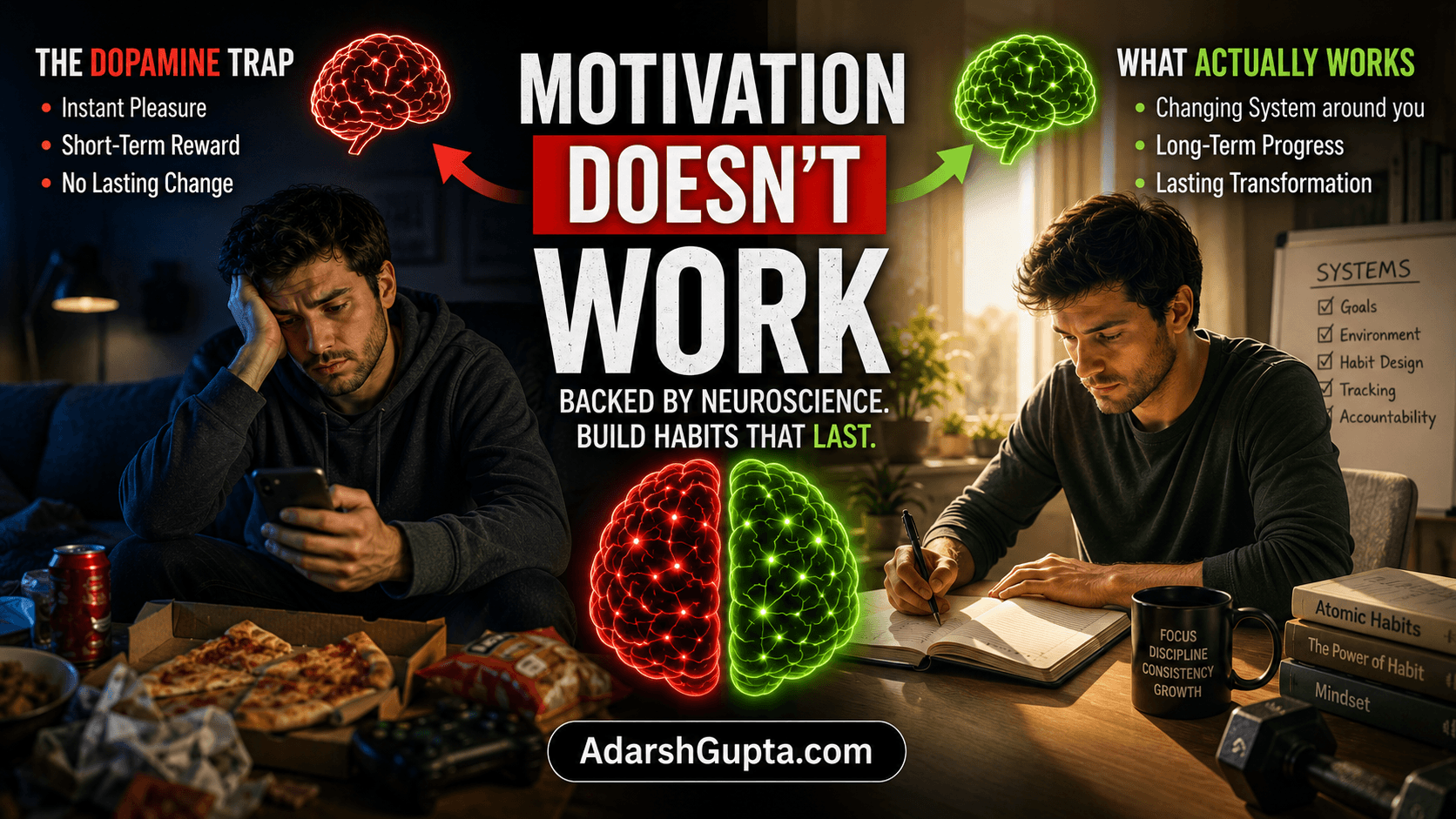
You woke up ready. You made a list. You told yourself this time is different. And by Thursday, the gym bag was still in the trunk and the salad ingredients had turned to liquid at the bottom of the crisper drawer.
This isn't a character flaw. It isn't laziness. And it isn't a problem you can fix by watching another motivational video.
The reason why motivation doesn't work is written into your neurobiology — and once you understand it, the failure starts to make perfect sense.
What Is Motivation, Scientifically Speaking?
Before explaining why motivation doesn't work, it helps to understand what motivation actually is at the biological level.
Motivation is a neurochemical state — primarily governed by dopamine — that drives you toward a perceived reward. When you imagine achieving a goal, your brain releases a small surge of dopamine. That feeling is motivation: the anticipatory pull toward something you expect to be good.
The problem is that dopamine is a wanting chemical, not a doing chemical. It creates the urge. It does not create the behavior.
Research from the University of Michigan found that dopamine is released most strongly during anticipation — before the reward — and drops sharply once the action phase begins. In other words, the neurochemical peak of motivation hits when you're making the plan, not when you're executing it. By the time the alarm goes off at 6 a.m., the dopamine spike from last night's resolution has already faded.
This is why motivation doesn't work as a foundation for lasting behavior change. It is, by design, temporary.
Why Motivation Doesn't Work as a Long-Term Strategy
Motivation is state-dependent. It requires specific conditions — energy, mood, low stress, a clear mind — to show up reliably. But life is not static.
Consider what happens to motivation when you sleep poorly, face a difficult day at work, experience a blood sugar crash at 3 p.m., or are simply grieving, anxious, or exhausted. In each of these states, motivation evaporates. And because most of the situations in which you need healthy habits are also the situations where you feel least motivated — stress eating, skipping exercise, abandoning sleep routines — motivation fails precisely when you need it most.
This is the core paradox: motivation is highest when life is easy, and lowest when behavior change matters most.
Roy Baumeister's research on ego depletion adds another layer. Willpower — the conscious enforcement of motivation — draws from a limited cognitive resource. Every decision you make throughout the day depletes that resource. By evening, even highly motivated people struggle to override their defaults because the mental fuel is simply gone.
Relying on motivation to sustain behavior change is like relying on your car's reserve tank to fuel a cross-country road trip. It works for a short stretch. Then you're stranded.
The Neuroscience Behind Motivation's Failure
The deeper neurological issue is that motivation operates in the prefrontal cortex — the brain's rational, planning center. This is the part of your brain that sets goals, weighs consequences, and imagines the future.
Habits, however, live in the basal ganglia — an ancient, automated structure that runs behavioral programs without requiring conscious input.
Here's what this means in practice: your prefrontal cortex decides you want to exercise every morning. But your basal ganglia has a well-worn program that says hit snooze, check your phone, make coffee. That program has been running for years. It is faster, more energy-efficient, and requires zero effort.
Every morning, you are asking a slow, effortful, resource-hungry brain region to override a fast, automatic, deeply encoded one. Motivation is the prefrontal cortex trying to win a fight it is neurologically disadvantaged in.
This is not a failure of character. It is a failure of strategy.
What Works Instead of Motivation
If motivation doesn't work, what does?
The answer is systems — specifically, habit loops that automate the behaviors you want so that motivation becomes irrelevant.
Charles Duhigg's work in The Power of Habit brought the habit loop to mainstream attention. James Clear built on this foundation in Atomic Habits, demonstrating that 1% improvements compound into dramatic change when systems — not motivation — drive them. The underlying neuroscience traces to MIT researcher Ann Graybiel's work on chunking: the process by which the brain packages repeated behaviors into automatic sequences. Once a behavior is chunked, the basal ganglia executes it with minimal prefrontal involvement. No motivation required.
Three evidence-based principles that replace motivation:
1. Environment design over willpower. Research from the University of Southern California shows that context — not intention — is the primary driver of habitual behavior. If you make the desired behavior the path of least resistance, you remove the need for motivation entirely. Sleeping in your gym clothes, putting your vitamins next to the coffee maker, keeping a water bottle on your desk — these are neurological interventions disguised as common sense.
2. Identity over outcomes. A 2019 study in Nature Human Behaviour found that people who framed exercise as an expression of who they are maintained behavior significantly longer than those who framed it as a goal. Carol Dweck's research in Mindset supports the same principle: identity-based framing creates durable behavior where goal-based motivation cannot.
Example: "I am someone who moves every day" is an identity statement. Every walk, every stretch, every morning routine confirms it — regardless of how you feel that morning. Contrast that with "I want to lose 20 pounds" — a goal that either succeeds or fails, with no identity to anchor you when motivation fades. One gives you something to live up to. The other gives you something to fall short of.
3. Friction reduction over discipline. Every step between you and a desired behavior creates friction that motivation must overcome. Reducing that friction — through preparation, automation, and simplification — accomplishes what motivation cannot.
The Habit Cycle: A More Reliable Framework
The four-phase Habit Cycle — Trigger, Craving, Action, Reward — offers a practical model for building behaviors that don't depend on motivation.
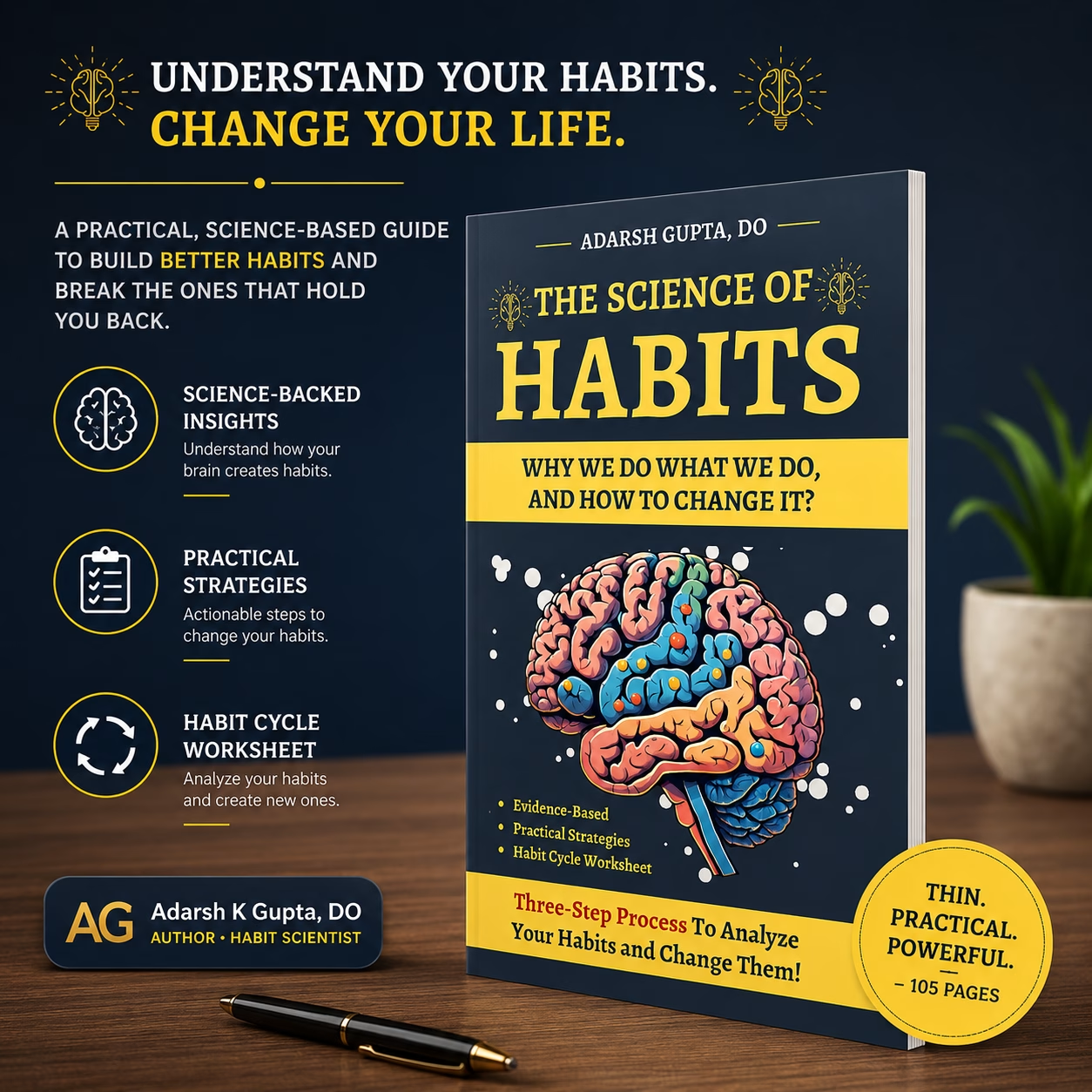
My book The Science of Habits walks through this framework in clinical detail, but the core principles are straightforward:
Trigger is the cue that initiates the behavior. A reliable trigger makes motivation irrelevant because the behavior starts automatically. The alarm goes off → you walk to your shoes. The coffee brews → you open your journal.
Craving is the anticipated reward that generates forward momentum. Unlike motivation, which is diffuse and abstract, a well-designed craving is specific and immediate. You're not exercising to "be healthier in 10 years." You're exercising because you know exactly how good the first cup of coffee tastes after a morning walk.
Action is the behavior itself — ideally scaled down to its smallest executable version to eliminate the friction that kills motivation. Two minutes is enough to start. Consistency first, intensity later.
Reward is the immediate payoff that signals to the basal ganglia that this sequence is worth encoding. The reward must be felt now, not in six months. A small, deliberate acknowledgment after completing the habit — even just noticing how you feel — is enough to close the loop.
When all four phases are working, the habit runs without motivation — because the brain has classified it as automatic, efficient, and rewarding.
Frequently Asked Questions
Why doesn't motivation work for long-term goals?
Motivation is a short-lived neurochemical state driven by dopamine anticipation. It peaks before action and fades quickly, especially under stress, fatigue, or decision fatigue. Long-term goals require automated habit systems, not sustained motivation.
Is it normal to lose motivation after a few days?
Yes — and it's neurologically expected. The dopamine surge that drives initial motivation dissipates as novelty wears off. This is not failure; it's biology. The solution is to build systems that don't require motivation to function.
What should I use instead of motivation?
Environment design, identity-based habit framing, and the four-phase Habit Cycle (Trigger, Craving, Action, Reward) are evidence-based alternatives. These approaches automate behavior rather than relying on a mental state that fluctuates daily.
Can motivation ever be useful?
Motivation is useful for starting — for initiating a new behavior once. It is not a reliable mechanism for repetition. Use motivation as an ignition switch, then build the habit infrastructure that keeps the engine running without it.
Why do I feel motivated but still not act?
This is the dopamine paradox: the brain rewards anticipation more than action. The neurochemical satisfaction of planning can substitute for doing. The fix is to reduce the gap between trigger and action — start before you feel ready, with the smallest possible version of the behavior.
The Bottom Line
Why motivation doesn't work isn't a mystery — it's neuroscience. Motivation is a temporary neurochemical state that operates in the wrong part of the brain to sustain long-term behavior change. It is state-dependent, resource-limited, and structurally disadvantaged against the deeply encoded habits it's trying to override.
The solution isn't more motivation. It's a better system.
Understanding your Habit Cycle — which of the four phases is weakest for you — is the first step to building behavior that doesn't depend on how you feel on a given morning.
Take the free Habit Cycle Score assessment to identify your weakest phase and get a personalized action plan.
References
- Berridge, K. C., & Robinson, T. E. (1998). What is the role of dopamine in reward: Hedonic impact, reward learning, or incentive salience? Brain Research Reviews, 28(3), 309–369.
- Baumeister, R. F., et al. (1998). Ego depletion: Is the active self a limited resource? Journal of Personality and Social Psychology, 74(5), 1252–1265.
- Wood, W., & Neal, D. T. (2007). A new look at habits and the habit-goal interface. Psychological Review, 114(4), 843–863.
- Graybiel, A. M. (2008). Habits, rituals, and the evaluative brain. Annual Review of Neuroscience, 31, 359–387.
- Duhigg, C. (2012). The Power of Habit. Random House.
- Clear, J. (2018). Atomic Habits. Avery.
- Dweck, C. S. (2006). Mindset. Random House.
- Gupta, A. K. (2024). The Science of Habits. Amazon.