
Body composition refers to the proportion of fat, muscle, bone, and other tissues in the body. It’s essential for overall health, athletic performance, and aesthetics. Body composition varies significantly between athletes, non-athletes, and genders. These differences are primarily due to the specific physiological demands of various sports and the natural biological variations between males and females.
When we talk about body composition, we are talking about the following components:
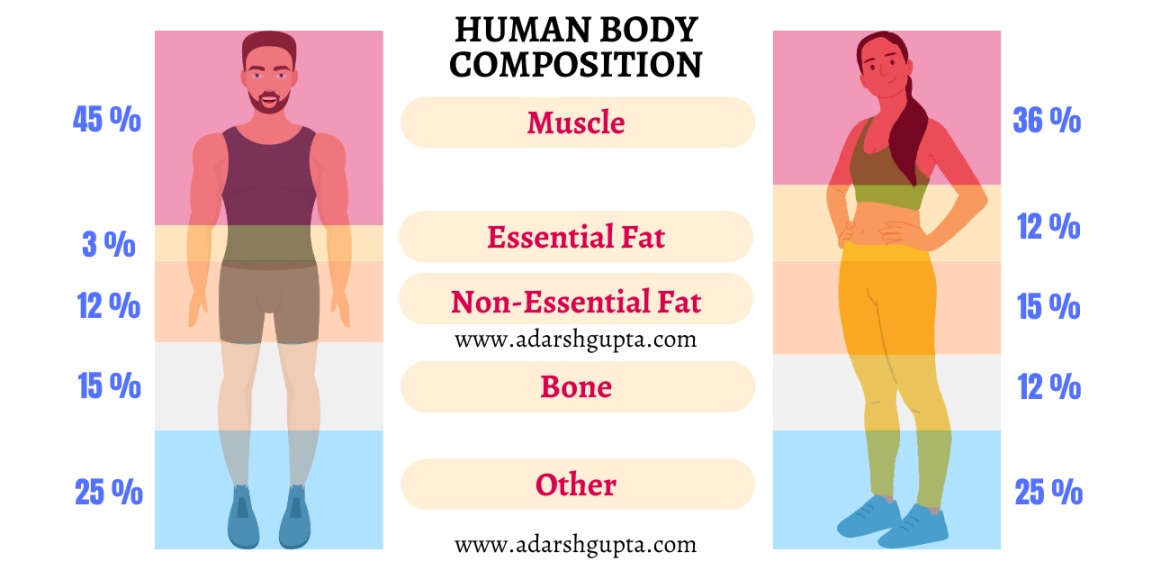
Human body composition is made up of several key components, including:
- Lean body mass: This includes muscles, bones, organs, and tissues and is essential for overall function and movement. Athletes often focus on increasing LBM to enhance strength and power.
- Body fat: This is the amount of fat in the body and can be further divided into essential fat (vital for normal physiological function) and storage fat (excess fat reserves). It’s important to keep in mind that body fat percentage is a key factor for both athletes and non-athletes. A healthy body fat percentage is something that everyone should strive for, but the ideal percentage can differ depending on factors such as age, gender, and the specific sport being pursued. While lower body fat percentages are generally linked to improved athletic performance, it’s crucial to avoid extreme leanness as it can have negative impacts on overall health and well-being.
- Water: The human body is composed of a large percentage of water, which is essential for various bodily functions. Each organ has water. For example, the brain and heart are composed of 73% water, and the lungs are about 83% water. The skin contains 64% water, muscles, and kidneys are 79%, and even the bones are watery: 31% 1.
- Minerals: These include calcium, potassium, and other essential minerals that contribute to overall body composition.
- Proteins are essential for building and repairing tissues and play a crucial role in various bodily functions.
These components collectively contribute to the overall composition of the human body and are important for maintaining health and well-being. Some models classify body composition into two components:
- Fat Mass: Comprised of fat (essential and non-essential)
- Fat-Free Mass: Comprised of muscle, bones, protein, minerals, and water.
Biological sex significantly influences body composition due to hormonal differences.
Let’s delve into the specifics of differences in body composition between athletes versus non-athletes:
Body Composition Differences between Athletes vs. Non-Athletes
Athletes generally have higher muscle mass and lower body fat percentages compared to sedentary individuals. This is especially true for strength and power athletes who engage in resistance training and sports-specific conditioning to build muscle.
On the other hand, endurance athletes may maintain slightly higher body fat percentages to support sustained energy during long periods of activity. It’s important to note that different sports have varying body composition requirements. For instance, endurance athletes such as distance runners and cyclists benefit from lower body fat percentages ranging from 5% to 15%, whereas power athletes like weightlifters and sprinters may tolerate slightly higher body fat percentages to support their athletic performance.
Gender Differences in Body Composition
Testosterone and estrogen play vital roles in the physiological differences between males and females. Testosterone, which is predominant in males, promotes muscle growth, while estrogen, which is predominant in females, affects fat distribution within the body.
Before the onset of puberty, there are minimal differences in athletic performance between pre-pubertal boys and girls. However, during puberty, hormonal changes lead to significant disparities in physical attributes and athletic capabilities between the two genders. During and after puberty, males experience a surge in testosterone levels, leading to various physical changes. These changes include the development of larger muscle fibers, particularly fast-twitch fibers, lower body fat, greater hemoglobin concentration, larger heart size, and longer limbs. As a result, adult males generally outperform females by 10%-30% in events requiring endurance or power. It is important to note that women’s athletic performance has significantly improved over the last century due to increased access to training, facilities, and opportunities. This increased access has helped to narrow the performance gap between males and females in the field of athletics.
Remember, these recommendations are general guidelines. Each person is unique, and personalized advice is crucial.
Athlete Body Fat Percentage Recommendations
- Endurance Sports (e.g., Distance Runners, Cyclists, Triathletes):
- Male Athletes: Typically aim for a body fat percentage of 5%-15%.
- Female Athletes: The recommended range is 8%-19%.
- These athletes need less fat to maintain lower weight while sustaining endurance performance.
- Aesthetic Sports (e.g., Figure Skating, Gymnastics, Diving):
- Both Genders: Aim for 6%-20% body fat.
- These sports emphasize aesthetics and flexibility. Lower body fat levels allow precise movements while still providing some cushioning for falls or jump landings.
- Power Sports (e.g., Football, Rugby, Lacrosse, Hockey):
- Both Genders: The optimal range is 15%-25% body fat.
- The explosive power required in these sports comes from a combination of fat and lean muscle mass. Slightly higher body fat helps supply consistent energy during intense bursts of effort.
- Weight Class Sports (e.g., Wrestling, Boxing, Martial Arts):
- Varies by Division: Athletes in weight-class sports need individualized body fat strategies based on competition needs.
- Too little body fat can risk over-dieting and affect performance.
Let’s explore the recommended body fat percentage ranges for non-athletes, both for men and women. Remember that these ranges provide general guidance, and individual variations exist based on factors like genetics, lifestyle, and health status.
[

](https://adarshgupta.com/dont-just-lose-weight-lose-inches-here-is-how/)
- Non-Athlete Men:
- Average Range: The average non-athlete man’s healthy body fat percentage typically falls between 18% and 24%.
- Sustainable and Lean: If you’re looking for a sustainable balance between muscle definition and overall health, aim for a range of around 14% to 20%
- Non-Athlete Women:
- Average Range: Non-athlete women tend to have slightly higher body fat percentages than men. The typical range for non-athlete women is 25% to 31%.
- Healthy and Sustainable: For women, a similar range that balances health and aesthetics would be around 21% to 28%
Remember that these are averages, and individual preferences and goals play a significant role. It’s essential to focus on overall well-being rather than striving for extreme leanness. If you have specific fitness goals or health concerns, consider consulting with a healthcare provider or a registered dietitian to tailor recommendations to your unique needs.
Assessment Methods for Body Composition
Method
Accuracy
Mechanism of Action
Cost
Features
Dual X-ray Absorptiometry (DXA)
Very accurate for fat and lean mass
Uses low-dose X-rays to differentiate between bone, fat, and lean tissue.
Moderate to high
Provides regional analysis (e.g., trunk, arms, legs). Commonly used in research and clinics.
Bioelectrical Impedance (BIA)
Reasonably accurate
Measures electrical impedance through body tissues. Fat conducts less electricity than lean tissue.
Low to moderate
Portable devices available. Quick and non-invasive. May vary based on hydration levels.
Air Displacement Plethysmography (Bod Pod)
Reasonably accurate
Measures body volume by air displacement. Calculates body density and estimates fat and lean mass.
Moderate to high
Non-invasive. Suitable for most populations. Requires specialized equipment.
Hydrostatic Weighing
Reasonably accurate
Measures body density by underwater weighing. Estimates fat and lean mass based on buoyancy.
Moderate to high
Requires access to a water tank. Used mainly in research settings.
Skinfold Thickness Measurements
Less accurate
Measures skinfold thickness at specific sites (e.g., triceps, abdomen). Estimates total body fat.
Low (requires calipers)
Simple and inexpensive. Operator-dependent. Used in field assessments and fitness settings.
Bioimpedance Spectroscopy (BIS)
Variable accuracy
Similar to BIA but uses multiple frequencies. Provides segmental analysis (arms, legs, trunk).
Moderate to high
Used in clinical and research settings. May require specialized equipment.
Remember that no method is perfect, and accuracy can vary based on factors like hydration, body type, and individual variation. Always consult with a healthcare professional or a registered dietitian to choose the most suitable method for your specific needs.
- Mitchell, H.H., Hamilton, T.S., Steggerda, F.R., and Bean, H.W., 1945, The chemical composition of the adult human body and its bearing on the biochemistry of growth: Journal of Biological Chemistry, v. 158, issue 3, p. 625-637. ↩︎