
Discover the science-backed benefits of coloring for stress reduction. Learn how this simple activity can improve your mental health and why it’s an effective tool for relaxation.
In recent years, adult coloring books have become popular, becoming a go-to tool for stress relief and relaxation. But what precisely about coloring makes it so effective in reducing stress and anxiety? Let’s dive into the science behind this seemingly simple yet powerful activity and explore why coloring works as a stress-reduction technique.
The Neuroscience of Coloring
Coloring has been shown to have calming effects on the mind, primarily through its ability to reduce anxiety and promote mindfulness. Research indicates that engaging in coloring activities can significantly decrease anxiety levels and improve emotional well-being. The following sections elaborate on the mechanisms and benefits of coloring as a calming practice.
Anxiety Reduction
- A randomized controlled trial demonstrated that adult coloring books significantly lowered anxiety levels in emergency department patients, with a mean decrease in anxiety scores of 3.7 after two hours of coloring1 (Rajendran et al., 2020).
- Participants reported higher engagement levels with coloring compared to a placebo, suggesting that the act of coloring itself is beneficial for mental health (Rajendran et al., 2020).
Mindfulness and Well-being
- Coloring promotes mindfulness, as evidenced by a study where participants showed increased mindfulness and decreased worry after engaging in coloring activities, regardless of mindfulness instructions2 (Singh, 2018).
- The act of coloring encourages focus and presence, which can help mitigate stress and rumination, contributing to overall well-being (Singh, 2018).
Emotional and Cognitive Effects of Color
- Different colors can evoke specific emotional responses; for instance, blue is associated with calming effects, enhancing relaxation and cognitive clarity3 (Bilucaglia et al., 2019).
- The cognitive benefits of coloring include improved focus and creativity, which can further contribute to a sense of calm4 (Holt et al., 2019).
Neurological Mechanisms
Research conducted by neurologists at the University of California demonstrated that coloring activates multiple regions of the brain simultaneously. The occipital lobe processes visual information while the frontal lobe engages in planning and decision-making regarding color choices and patterns. According to Curry and Kasser (2005)5, this bilateral brain activation while coloring mandalas creates a state similar to meditation, where focused attention promotes neural synchronization.
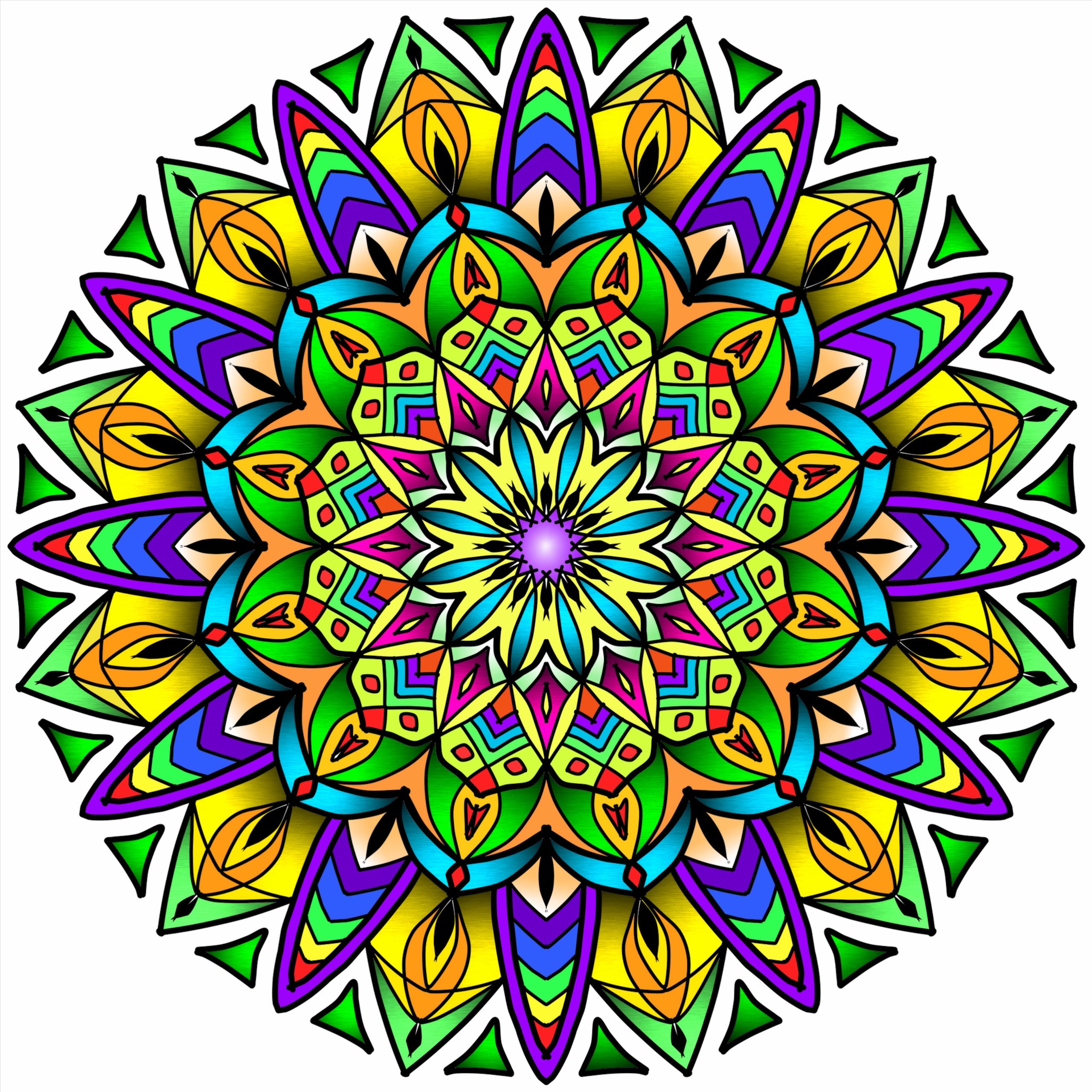
Studies using EEG monitoring have shown that coloring induces a state similar to meditation, known as the “alpha state” in the brain which is associated with a relaxed but alert state. These brain waves, typically present during meditative states, indicate reduced stress and increased mindfulness6 (Carsley et al., 2015).
Psychological Benefits of Coloring
Beyond its neurological effects, coloring offers several psychological benefits that contribute to stress reduction:
Flow State and Stress Relief
A landmark study in the Art Therapy Journal found that 30 minutes of coloring mandalas significantly reduced anxiety levels in participants. The structured nature of coloring provides what psychologists call “flow state” – a mental state of complete absorption and focus that reduces anxious thoughts. When a person is in a “flow state,” the person is fully absorbed in the activity. This state of flow is associated with reduced stress and increased happiness. When we’re in flow, we lose track of time and our surroundings, providing a much-needed mental break from daily stressors.
The element of choice in selecting colors and deciding how to fill spaces gives individuals a sense of control, which psychologists identify as crucial for stress management. According to research by Bell and Robbins (2007)7, this combination of structure and creative freedom makes coloring particularly effective for anxiety reduction.
Coloring requires concentration on the task at hand, which naturally draws our attention away from stressors and worries. This focus on the present moment is a key component of mindfulness, a practice known for its stress-reducing properties. By engaging in coloring, we practice being present, which can help alleviate anxiety about the future or rumination about the past.
Short-Term Benefits of Daily Coloring
Research has shown that even short coloring sessions can have immediate benefits. A study found that participants who colored for just 20 minutes daily experienced decreased stress and increased relaxation8. While long-term effects were not as pronounced, the immediate stress relief provided by coloring can be a valuable tool for managing daily stressors.
Physiological Effects of Coloring
The benefits of coloring extend beyond mental states to affect our physical well-being:
Lowered Heart Rate and Blood Pressure
Monitoring of vital signs during coloring activities has revealed measurable physical effects. Studies have documented:
- Decreased heart rate
- Lower blood pressure
- Reduced cortisol levels
- Normalized breathing patterns
These physiological changes mirror those seen in traditional relaxation techniques, suggesting that coloring triggers the body’s natural relaxation response (van der Vennet & Serice, 2012).9
[

](https://amzn.to/4gCeIIL)
[

](https://amzn.to/4j2KReb)
Incorporating Coloring into Your Stress-Reduction Routine
To maximize the stress-reducing benefits of coloring, consider the following tips:
- Choose the right materials: Select coloring books and tools that appeal to you. Whether you prefer intricate mandalas or simpler patterns, find designs that you enjoy.
- Set aside dedicated time: Even 10-20 minutes of coloring can provide benefits. Try to make it a regular part of your routine.
- Create a relaxing environment: Find a quiet, comfortable space to color. Consider adding calming music or aromatherapy to enhance the relaxation experience.
- Practice mindfulness while coloring: Focus on the sensations of coloring – the feel of the pencil or marker, the sound it makes on the paper, and the colors you’re using.
- Use coloring as a break: When feeling overwhelmed, take a short coloring break to reset your mind and reduce stress levels.
Conclusion
The science behind coloring as a stress-reduction technique is compelling. By engaging multiple areas of the brain, promoting mindfulness, and inducing a state of relaxation, coloring offers a simple yet effective way to manage stress and anxiety. Whether you’re dealing with daily stressors or looking for a new way to unwind, picking up a coloring book might just be the colorful solution you need for a calmer, more balanced life.As research continues to explore the benefits of coloring, it’s clear that this activity is more than just a passing trend. It’s a scientifically-supported tool for improving mental health and well-being. So the next time you feel stressed, remember that relief might be just a few colored pencils away.
References
- Rajendran N, Mitra TP, Shahrestani S, Coggins A. Randomized Controlled Trial of Adult Therapeutic Coloring for the Management of Significant Anxiety in the Emergency Department. Acad Emerg Med. 2020 Feb;27(2):92-99. doi: 10.1111/acem.13838. Epub 2020 Jan 20. PMID: 31957143. ↩︎
- Singh, Navreen K.. “Does colouring promote mindfulness and enhance wellbeing? : a randomised controlled trial.” (2018). ↩︎
- Bilucaglia M, Laureanti R, Zito M, Circi R, Fici A, Rivetti F, Valesi R, Wahl S, Russo V. Looking through blue glasses: bioelectrical measures to assess the awakening after a calm situation. Annu Int Conf IEEE Eng Med Biol Soc. 2019 Jul;2019:526-529. doi: 10.1109/EMBC.2019.8856486. PMID: 31945953. ↩︎
- Holt, N. J., Furbert, L., & Sweetingham, E. (2019). Cognitive and Affective Benefits of Coloring: Two Randomized Controlled Crossover Studies. Art Therapy, 36(4), 200–208. https://doi.org/10.1080/07421656.2019.1645498 ↩︎
- Curry, N. A., & Kasser, T. (2005). Can Coloring Mandalas Reduce Anxiety? Art Therapy, 22(2), 81–85. https://doi.org/10.1080/07421656.2005.10129441 ↩︎
- Carsley, D., Heath, N. L., & Fajnerova, S. (2015). Effectiveness of a Classroom Mindfulness Coloring Activity for Test Anxiety in Children. Journal of Applied School Psychology, 31(3), 239–255. https://doi.org/10.1080/15377903.2015.1056925 ↩︎
- Bell, C. E., & Robbins, S. J. (2007). Effect of Art Production on Negative Mood: A Randomized, Controlled Trial. Art Therapy, 24(2), 71–75. https://doi.org/10.1080/07421656.2007.10129589 ↩︎
- Ashdown, B. K, Bodenlos, J. S., Arroyo, K., Patterson, M., Parkins, E., & Burstein, S. (2018). HOW DOES COLORING INFLUENCE MOOD, STRESS, AND MINDFULNESS? Journal of Integrated Social Sciences, 8(1), 1-21 ↩︎
- van der Vennet, R., & Serice, S. (2012). Can coloring mandalas reduce anxiety? A replication study. Art Therapy, 29(2), 87–92. https://doi.org/10.1080/07421656.2012.680047
↩︎